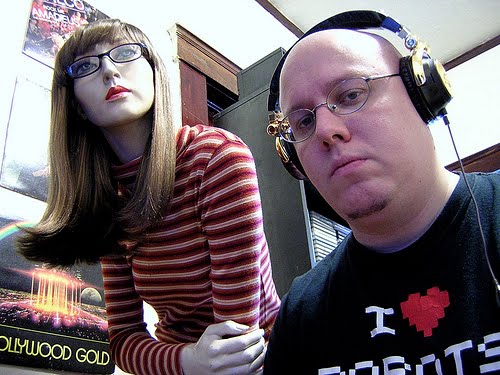
Here is a list of people attempting entry to our abode.
Allow them.
Thursday, April 15, 2010

Saturday, September 26, 2009
Why Video Games Are Making Films Obsolete (But Not Books)
I've never been a particularly big fan of movies. Sure, I have a few favorites from over the three and a half decades of my life, but I've also seen far less than your average person. Indeed, people are often shocked when they hear some of the movies I have not seen (included on that list: Akira, The Godfather, The Shawshank Redemption, The Princess Bride, The Goonies). Furthermore, most of the ones I have seen have been via television (in the forms of VHS, DVD or cable), whose tortured, senile death throes I have already discussed at length elsewhere on this blog.
The movie house, like the stage theater, is a dying space. Certainly it will always have its aficionados, but its usefulness as a provider of social memes and connecting experiences is decreasing every year. For starters, people have more options for experiencing film due to increased and increasing technological freedoms. No longer must the blockbuster movie come with the implied agreement of noisy audiences, gumshoe aisles, a ten-dollar ticket price and thirty minutes of commercials. Indeed, some filmmakers are now choosing to release DVD and online streaming version of their films concurrent with the "proper" theatrical release. The reasoning is simple: people want control of their media.
And that is exactly the reason why films are becoming obsolete, while their red-headed stepchild, video games, becomes more and more engaging. Films strip much of the control mechanism away from media by their very design. It's only now, faced with the extinction of their entire distribution network, that studios even allow for such alternate means of viewing experience. Films are passive, while video games (and, oddly enough, books, the precursor to film in the realm of narrative delivery) are interactive.
Wait, what? Did I just say that books are more interactive than films? I did. It's one of the many ways in which literature is superior to the cinema as a vessel for storytelling, and since you're clearly incredulous now, I'll explain why.
Books allow the reader control over the environment. When you read a book, you envision how the characters look based on the descriptions provided by the author. You envision how buildings, stretches of land, entire planets look via the author's cues -- but that is your envisioning. It's different from everyone else who reads the book. Until Lord of the Rings was a series of Peter Jackson films, no two people thought of Frodo as looking the same; of course, now that film has tainted our collective social consciousness, it's almost impossible to think of him as not looking like Elijah Wood. Film takes away your ability to create the environment for a narrative. (I've discussed that at length before, too.)
In contrast, a video game provides a fully-rendered environment, but gives you control of the action. In a video game, you control the character's path. The narrative is one that you provide yourself, choosing which direction to go next, which challenges to surmount. Many video games do indeed lead the player into a simplistic, linear path, but even those that do never play the game for you. Film does exactly that. In film, the viewer has neither control of the action nor the environment. The control mechanism is removed entirely, providing a purely passive experience.
Timing is another element of control that film robs from the viewer. In a book, you can linger on a page, a paragraph, or a sentence as long as you like, savoring the emotion of the moment that the words provide you. In a video game, you control the rate at which the character progresses, both in a literal and metaphorical sense; even games with a level timer do not ensure that you will use the exact amount of seconds to reach the end of the stage. But in film, timing is everything. Shots are timed to convey the performance required by the director. Cuts are editted to maximize the flow of the story by the producer. Films rarely escape the two-hour Golden Rule, which itself is timed so as not to risk conflicting with our biological clocks, since no one wants to go to the restroom in the middle of a film. Even the release of films is timed to meet up with summer movie habits or Oscar nominations; television does this too, with its tried-and-true "tune in next week" format to keep us coming back to the screen every week at the same hour.
All of these variables point to a very interesting trend: people are now deciding that they want control of their experiences. They no longer desire to be stuffed into a train car and taken, blindfolded, to their destination. They want to enjoy the journey; they want to conduct the train. This is exhibited in other forms of modern art as well, music being the immediate example. Mash-ups, covers and sampling have become commonplace. The line between producer and listener blurs more by the day. Bedroom composers create songs to rival the professionals; Jonathon Coulton, Owl City and Lady Wallace all have followings as large as any fly-by-night pop icon. Again, the reason is that technology is now so cheap and ubiquitous that the tools for anyone to become an auteur are readily available.
This points us to the other prevailing reason that film is going to die: it takes much more money to make a movie or a television show than it does to make a book or a video game. A-list stars, Redrock depth-of-field adapters, over-the-top CGI rendering, on-location site licensing, endless legions of producers and co-producers and executive producers -- all the things required to make a film add up to hundreds of millions of dollars. No book or video game has ever cost so much, though video games are getting close these days; Grand Theft Auto IV cost a whopping one hundred million to make, but that's an extreme exception, and on average a current generation console game costs about fifteen million, which is still nowhere near movie budgets. (For comparison, a hundred million in Hollywood will get you The Adventures of Pluto Nash.) Novels, it almost goes without saying, come nowhere near these costs; putting words on a page will set you back maybe a five thousand dollar investment.
What we have, then, is an entertainment industry which firstly costs more than any other to maintain, and secondly is no longer able to deliver the demands of its target audience. This is an equation for bankruptcy. Most damning of all is that the industry knows this; even Speilberg, Hollywood's messiah, is dumping buckets of money into exploring new options in 3D technology, just to keep his floundering artform fresh.
I do like film. I've gotten a number of grand experiences out of the medium of cinema. I can't, however, look the other way as that medium continues to vaunt itself as the arbiter of culture, when it is clear to me that its authority in such matters has become dubious and suspect.
Once, when I was visiting my mother, I found that her computer had a DVD playing program that would increase or decrease the speed of a film while keeping the audio the correct pitch; you could take a movie up to two hundred percent of its original speed without making the actors sound like chipmunks. Amused by the possibilities, I immediately decided to watch Star Wars Episode Two: Attack Of The Clones. At its normal speed, the bloated epic seemed merely forced and pompous; compressed to a single hour, however, it became a blistering onslaught of visual sensation akin to an acid trip. Lightsaber battles were resolved in a matter of seconds. Ponderous love scenes were now paced as frantic adolescent make-out sessions. Languorous dialogue became rapid-fire sarcasm. In truth, the movie was far more enjoyable than it had been in its official timing. But you'll never see it in the theater like that.
The movie house, like the stage theater, is a dying space. Certainly it will always have its aficionados, but its usefulness as a provider of social memes and connecting experiences is decreasing every year. For starters, people have more options for experiencing film due to increased and increasing technological freedoms. No longer must the blockbuster movie come with the implied agreement of noisy audiences, gumshoe aisles, a ten-dollar ticket price and thirty minutes of commercials. Indeed, some filmmakers are now choosing to release DVD and online streaming version of their films concurrent with the "proper" theatrical release. The reasoning is simple: people want control of their media.
And that is exactly the reason why films are becoming obsolete, while their red-headed stepchild, video games, becomes more and more engaging. Films strip much of the control mechanism away from media by their very design. It's only now, faced with the extinction of their entire distribution network, that studios even allow for such alternate means of viewing experience. Films are passive, while video games (and, oddly enough, books, the precursor to film in the realm of narrative delivery) are interactive.
Wait, what? Did I just say that books are more interactive than films? I did. It's one of the many ways in which literature is superior to the cinema as a vessel for storytelling, and since you're clearly incredulous now, I'll explain why.
Books allow the reader control over the environment. When you read a book, you envision how the characters look based on the descriptions provided by the author. You envision how buildings, stretches of land, entire planets look via the author's cues -- but that is your envisioning. It's different from everyone else who reads the book. Until Lord of the Rings was a series of Peter Jackson films, no two people thought of Frodo as looking the same; of course, now that film has tainted our collective social consciousness, it's almost impossible to think of him as not looking like Elijah Wood. Film takes away your ability to create the environment for a narrative. (I've discussed that at length before, too.)
In contrast, a video game provides a fully-rendered environment, but gives you control of the action. In a video game, you control the character's path. The narrative is one that you provide yourself, choosing which direction to go next, which challenges to surmount. Many video games do indeed lead the player into a simplistic, linear path, but even those that do never play the game for you. Film does exactly that. In film, the viewer has neither control of the action nor the environment. The control mechanism is removed entirely, providing a purely passive experience.
Timing is another element of control that film robs from the viewer. In a book, you can linger on a page, a paragraph, or a sentence as long as you like, savoring the emotion of the moment that the words provide you. In a video game, you control the rate at which the character progresses, both in a literal and metaphorical sense; even games with a level timer do not ensure that you will use the exact amount of seconds to reach the end of the stage. But in film, timing is everything. Shots are timed to convey the performance required by the director. Cuts are editted to maximize the flow of the story by the producer. Films rarely escape the two-hour Golden Rule, which itself is timed so as not to risk conflicting with our biological clocks, since no one wants to go to the restroom in the middle of a film. Even the release of films is timed to meet up with summer movie habits or Oscar nominations; television does this too, with its tried-and-true "tune in next week" format to keep us coming back to the screen every week at the same hour.
All of these variables point to a very interesting trend: people are now deciding that they want control of their experiences. They no longer desire to be stuffed into a train car and taken, blindfolded, to their destination. They want to enjoy the journey; they want to conduct the train. This is exhibited in other forms of modern art as well, music being the immediate example. Mash-ups, covers and sampling have become commonplace. The line between producer and listener blurs more by the day. Bedroom composers create songs to rival the professionals; Jonathon Coulton, Owl City and Lady Wallace all have followings as large as any fly-by-night pop icon. Again, the reason is that technology is now so cheap and ubiquitous that the tools for anyone to become an auteur are readily available.
This points us to the other prevailing reason that film is going to die: it takes much more money to make a movie or a television show than it does to make a book or a video game. A-list stars, Redrock depth-of-field adapters, over-the-top CGI rendering, on-location site licensing, endless legions of producers and co-producers and executive producers -- all the things required to make a film add up to hundreds of millions of dollars. No book or video game has ever cost so much, though video games are getting close these days; Grand Theft Auto IV cost a whopping one hundred million to make, but that's an extreme exception, and on average a current generation console game costs about fifteen million, which is still nowhere near movie budgets. (For comparison, a hundred million in Hollywood will get you The Adventures of Pluto Nash.) Novels, it almost goes without saying, come nowhere near these costs; putting words on a page will set you back maybe a five thousand dollar investment.
What we have, then, is an entertainment industry which firstly costs more than any other to maintain, and secondly is no longer able to deliver the demands of its target audience. This is an equation for bankruptcy. Most damning of all is that the industry knows this; even Speilberg, Hollywood's messiah, is dumping buckets of money into exploring new options in 3D technology, just to keep his floundering artform fresh.
I do like film. I've gotten a number of grand experiences out of the medium of cinema. I can't, however, look the other way as that medium continues to vaunt itself as the arbiter of culture, when it is clear to me that its authority in such matters has become dubious and suspect.
Once, when I was visiting my mother, I found that her computer had a DVD playing program that would increase or decrease the speed of a film while keeping the audio the correct pitch; you could take a movie up to two hundred percent of its original speed without making the actors sound like chipmunks. Amused by the possibilities, I immediately decided to watch Star Wars Episode Two: Attack Of The Clones. At its normal speed, the bloated epic seemed merely forced and pompous; compressed to a single hour, however, it became a blistering onslaught of visual sensation akin to an acid trip. Lightsaber battles were resolved in a matter of seconds. Ponderous love scenes were now paced as frantic adolescent make-out sessions. Languorous dialogue became rapid-fire sarcasm. In truth, the movie was far more enjoyable than it had been in its official timing. But you'll never see it in the theater like that.
Sunday, July 5, 2009
World of Patience
I've been playing World of Warcraft for about six months now, after my pal Chronkite finally convinced me to try it. I don't consider myself an expert by any stretch of the imagination. There's certainly plenty of facets that I don't have any experience in (warrior class, dual talent trees, anything related to Outland or Northrend), but I've amassed far more knowledge about the game than the common non-player has at their disposal.
After the intoxicating Battlegrounds experience, I wanted a new challenge, something that was really bizarre. Sure, there were challenges waiting ahead in Burning Steppes and past the Dark Portal, but my highest toon (WoW slang for “character”) is a good 15 levels away from exploring those domains.
Then it hit me: what if I tried going through the game without killing anything? If I could get to level 80 without ever fighting, that would be so totally badass!
So I rolled a new toon. Without thinking too much about the dynamics of race and class attributes, I chose a human rogue, which ended up being a pretty decent choice (though in retrospect, night elf would have been far better, for reasons I'll try to explain later). I then set myself the following rule: I will not allow my Creatures Killed stat to rise above zero. In my first defiant act, I sold off my starter weapon. After all, I wouldn't be needing it.
It goes without saying that a game that is literally named “planet where the art of murdering is practiced” tends to lead the player into killing things. A good many of the available entry quests send you to outright slaughter wild pigs, encroaching kobold miners, giant moths, and a plethora of other species. Some players cheekily refer to these as the “racial cleansing” quests.
Additionally, a large percentage of the remaining quests have you fetch objects from various hostiles, such as candles, bandanas, vials of animal blood, or simply slabs of meat. For the most part (and I'll explain the exceptions below), you can't do these quests without killing the possessors of the objects first, so those are out as well.
So what's left? Well, in short:
- Courier quests. Many NPCs will send you to talk to another NPC across town, across the zone, in another zone, or even on another landmass. A subclass of this type of quest has you bring the NPC some sort of item, such as a note or needed supplies. Another subclass is when you get sent to find someone who has become lost in an area.
- Search quests. In this type of mission you go around an environment searching for things to pick up (like lost ship parts, a stolen heirloom or certain kinds of flowers) or to leave behind (such as taking a dead person's remains to be buried).
- Holiday quests. WoW has a number of in-game holidays that give players certain non-violent tasks to perform. For example, as of this writing the game is celebrating Midsummer, whose various activities include juggling torches, honoring flame keepers and – I swear I'm not kidding – pissing on the enemy's fires. The downside to these, of course, is that holidays are exceptions rather than continuous events.
To get enough XP (experience points, for the laymen) to go up to level 2, I had to run around to all four starting areas and do whatever quests I could do within these parameters. This in itself was particularly trying, due to these areas being quite far from one another. Getting from the mountainous dwarf lands to the island of the alien Draenei, for example, requires taking two boats and a tram. Additionally, since it is a world of warfare, things are trying to kill you all the time, and they don't seem to have much use for the Golden Rule. The dwarf / gnome starting area can only be accessed through a tunnel, and in the tunnel is an infestation of level 4 troggs. Level 4! It seems so dismissive from the perspective of a level 44, sword-swinging paladin, but to my new toon it was a sheer terror in Neanderthal form.
Here's a screenshot to show you what I had to work with:

Those of you who play WoW are doubtlessly laughing furiously right now due to the actionbar. For those that don't, here's a general explanation of what those buttons on the bottom left do.
[1] Eat cheese
[2] Drink healing potion
[3] Build a campfire
[4] Cook food
[5] Go fishing
[6] Pick flowers
[7] Mine mineral deposits
[8] Melt down minerals into ingots
[9] Teleport back to an inn
[0] Check my location coordinates
[-] Do a dance
[=] Bring out a little robot, who follows me around but does nothing (a free gift from our good friends at Mountain Dew. No, seriously.)
So: I can catch fish, cook and eat food, take drugs, set fires, dig up plants and rocks, play with pets, and boogie down. And I don't fight anything, and run away when attacked. I may be the first ever digital hippie.
I learned some fairly complex techniques pretty rapidly. The rogue has an ability called Stealth (the unlabeled button right above button 2), which allows me to sneak around largely undetected, but at half speed. The higher a creature is in level from me, though, the more likely they will spot me even in a cloaked state – and then, my only real remaining option is to run like Hell. This is actually where the night elf race would have had a better advantage; they have a racial ability called Shadowmeld, which is similar to Stealth, but also allows the player to break combat. A night elf rogue can use Shadowmeld to hide from an attacking enemy until their Stealth spell recharges, and then continue as before. The human racial, in contrast, is called Every Man For Himself, which breaks the toon free of movement constrictions such as traps or stun effects. It's decently useful in certain cases, but Shadowmeld would have been far more so.
Another thing I eventually realized was that some of the quests that required items from creatures could be done if I purchased the items rather than killed creatures for them. WoW has a number of Auction Houses, which are basically a sort of in-game eBay for trading armor, weapons and other things for gold pieces. This is where the first real test of my “virtual morality” came into play. After all, someone had to kill those Crag Boars to get the meat to sell to me, so am I just an enabler for killing by doing the quest at all? The game wasn't going to count it as my kill, though, and it's not like I could go back and un-kill the animal. Someone was going to buy that Crag Boar Meat, so it might as well be me!
But why single out quests? There are food items in the Auction House that can be consumed by players to regain health, and for the most part, those came from players who cooked it (using the Cooking skill). If it's a meat-based item, it's a done deal that someone killed something to make this meal. Should my toon become a vegetarian?
For that matter, why bother with the Auction House at all? I could simply log in under one of my other toons (my paladin, for example), kill some boars, loot their meat, and send it to the first toon using the in-game mail system. It wouldn't count under the pacifist's stats – but it would be me, the player, doing the killing regardless. It's the old Nazi closed circuit of responsibility, “I was only following orders” versus “I only gave orders, I never actually did anything.” How much functional schizophrenia was I willing to accept to fudge the rules?
It should be noted at this point that under normal (in other words, kill-happy) circumstances, a new toon takes about an hour or two to go from level 1 to 5. My conscientious objector toon took a full day to gain the same amount of experience. Much of this can be attributed to travel times between the sections I was able to acquire viable quests from. Additionally, sometimes a quest couldn't be done for logistical purposes; a gathering quest infested by level 4 monsters, for example, was inadvisable until I was at least level 4 myself, or they would have easily spotted me even under stealth. That meant I had to go find enough other quests to get me to level 4 just to do that quest. Rapidly my gameplay descended into a sort of fantasy flowchart, wherein I was always trying to get around the functional restrictions using any path available.
My biggest moment of doubt came on the night elf island, where I was sent on a quest to pull up plant seedlings before they mutated into lumbering elemental monsters. Since the seedlings are environmental objects and not actual monsters, I took the quest knowing that the game would not count a simple digging quest as creature kills – but when I got to the first seedling, my whole perspective took a sideswipe to the port quarter. Opening up the flower-like pods revealed a very human-looking face within, which twitched and glared nervously as it awaited its fate at my hand, unable to defend itself from my ultimate decision. I felt something in the pit of my stomach that I can only assume, if you'll excuse the arrogance of the assumption, was akin to how a mother feels when she makes the decision to abort her fetus.
However nebulous the ethical quandaries I might be faced with became due to my decision to play the game is this manner, I had in fact set for myself a very simple rule that could not be misinterpreted: do nothing that makes your Creature Kills stat rise above zero. Nothing I had done so far had broken that rule. I had to keep reminding myself that: I had done nothing to break the rule.
I pulled up the squirming seedling, along with eleven of its siblings.
I am not the first person to play WoW in this manner, nor even close to the best. Another player, whose toon is a gnome rogue known as Noor, has made it all the way to level 80, the current level cap for the latest expansion. I take solace in Noor's achievement, because it provides a most important proof of concept: you can go all the way to the top without killing a single creature.
The initial decision to play a non-combat character was not grounded in any moral structure. All I was thinking about was a single statistic on a character sheet; I literally only saw one defining numeral. As the journey towards that goal took shape, though, I found myself examining the fabric of morality itself, my actions and the decisions that guided those actions playing out in a simulated world where the shifting natures of hypocrisy and compromise became all too real considerations.
Chronkite, having heard about my strange experiment, decided to give it a whirl himself. He rolled a new toon, a Draenei priest. After an hour, he admitted defeat, praising me for my tenacity in the face of overwhelming odds. If nothing else comes of this, I will at least have that rock to stand on: the patience required to keep my eyes on the prize as I play Animal Crossing in the midst of Duke Nukem, picking flowers while fighters and mages obliterate demons on the periphery of my sight.
After the intoxicating Battlegrounds experience, I wanted a new challenge, something that was really bizarre. Sure, there were challenges waiting ahead in Burning Steppes and past the Dark Portal, but my highest toon (WoW slang for “character”) is a good 15 levels away from exploring those domains.
Then it hit me: what if I tried going through the game without killing anything? If I could get to level 80 without ever fighting, that would be so totally badass!
So I rolled a new toon. Without thinking too much about the dynamics of race and class attributes, I chose a human rogue, which ended up being a pretty decent choice (though in retrospect, night elf would have been far better, for reasons I'll try to explain later). I then set myself the following rule: I will not allow my Creatures Killed stat to rise above zero. In my first defiant act, I sold off my starter weapon. After all, I wouldn't be needing it.
---
It goes without saying that a game that is literally named “planet where the art of murdering is practiced” tends to lead the player into killing things. A good many of the available entry quests send you to outright slaughter wild pigs, encroaching kobold miners, giant moths, and a plethora of other species. Some players cheekily refer to these as the “racial cleansing” quests.
Additionally, a large percentage of the remaining quests have you fetch objects from various hostiles, such as candles, bandanas, vials of animal blood, or simply slabs of meat. For the most part (and I'll explain the exceptions below), you can't do these quests without killing the possessors of the objects first, so those are out as well.
So what's left? Well, in short:
- Courier quests. Many NPCs will send you to talk to another NPC across town, across the zone, in another zone, or even on another landmass. A subclass of this type of quest has you bring the NPC some sort of item, such as a note or needed supplies. Another subclass is when you get sent to find someone who has become lost in an area.
- Search quests. In this type of mission you go around an environment searching for things to pick up (like lost ship parts, a stolen heirloom or certain kinds of flowers) or to leave behind (such as taking a dead person's remains to be buried).
- Holiday quests. WoW has a number of in-game holidays that give players certain non-violent tasks to perform. For example, as of this writing the game is celebrating Midsummer, whose various activities include juggling torches, honoring flame keepers and – I swear I'm not kidding – pissing on the enemy's fires. The downside to these, of course, is that holidays are exceptions rather than continuous events.
To get enough XP (experience points, for the laymen) to go up to level 2, I had to run around to all four starting areas and do whatever quests I could do within these parameters. This in itself was particularly trying, due to these areas being quite far from one another. Getting from the mountainous dwarf lands to the island of the alien Draenei, for example, requires taking two boats and a tram. Additionally, since it is a world of warfare, things are trying to kill you all the time, and they don't seem to have much use for the Golden Rule. The dwarf / gnome starting area can only be accessed through a tunnel, and in the tunnel is an infestation of level 4 troggs. Level 4! It seems so dismissive from the perspective of a level 44, sword-swinging paladin, but to my new toon it was a sheer terror in Neanderthal form.
---
Here's a screenshot to show you what I had to work with:

Those of you who play WoW are doubtlessly laughing furiously right now due to the actionbar. For those that don't, here's a general explanation of what those buttons on the bottom left do.
[1] Eat cheese
[2] Drink healing potion
[3] Build a campfire
[4] Cook food
[5] Go fishing
[6] Pick flowers
[7] Mine mineral deposits
[8] Melt down minerals into ingots
[9] Teleport back to an inn
[0] Check my location coordinates
[-] Do a dance
[=] Bring out a little robot, who follows me around but does nothing (a free gift from our good friends at Mountain Dew. No, seriously.)
So: I can catch fish, cook and eat food, take drugs, set fires, dig up plants and rocks, play with pets, and boogie down. And I don't fight anything, and run away when attacked. I may be the first ever digital hippie.
I learned some fairly complex techniques pretty rapidly. The rogue has an ability called Stealth (the unlabeled button right above button 2), which allows me to sneak around largely undetected, but at half speed. The higher a creature is in level from me, though, the more likely they will spot me even in a cloaked state – and then, my only real remaining option is to run like Hell. This is actually where the night elf race would have had a better advantage; they have a racial ability called Shadowmeld, which is similar to Stealth, but also allows the player to break combat. A night elf rogue can use Shadowmeld to hide from an attacking enemy until their Stealth spell recharges, and then continue as before. The human racial, in contrast, is called Every Man For Himself, which breaks the toon free of movement constrictions such as traps or stun effects. It's decently useful in certain cases, but Shadowmeld would have been far more so.
Another thing I eventually realized was that some of the quests that required items from creatures could be done if I purchased the items rather than killed creatures for them. WoW has a number of Auction Houses, which are basically a sort of in-game eBay for trading armor, weapons and other things for gold pieces. This is where the first real test of my “virtual morality” came into play. After all, someone had to kill those Crag Boars to get the meat to sell to me, so am I just an enabler for killing by doing the quest at all? The game wasn't going to count it as my kill, though, and it's not like I could go back and un-kill the animal. Someone was going to buy that Crag Boar Meat, so it might as well be me!
But why single out quests? There are food items in the Auction House that can be consumed by players to regain health, and for the most part, those came from players who cooked it (using the Cooking skill). If it's a meat-based item, it's a done deal that someone killed something to make this meal. Should my toon become a vegetarian?
For that matter, why bother with the Auction House at all? I could simply log in under one of my other toons (my paladin, for example), kill some boars, loot their meat, and send it to the first toon using the in-game mail system. It wouldn't count under the pacifist's stats – but it would be me, the player, doing the killing regardless. It's the old Nazi closed circuit of responsibility, “I was only following orders” versus “I only gave orders, I never actually did anything.” How much functional schizophrenia was I willing to accept to fudge the rules?
It should be noted at this point that under normal (in other words, kill-happy) circumstances, a new toon takes about an hour or two to go from level 1 to 5. My conscientious objector toon took a full day to gain the same amount of experience. Much of this can be attributed to travel times between the sections I was able to acquire viable quests from. Additionally, sometimes a quest couldn't be done for logistical purposes; a gathering quest infested by level 4 monsters, for example, was inadvisable until I was at least level 4 myself, or they would have easily spotted me even under stealth. That meant I had to go find enough other quests to get me to level 4 just to do that quest. Rapidly my gameplay descended into a sort of fantasy flowchart, wherein I was always trying to get around the functional restrictions using any path available.
My biggest moment of doubt came on the night elf island, where I was sent on a quest to pull up plant seedlings before they mutated into lumbering elemental monsters. Since the seedlings are environmental objects and not actual monsters, I took the quest knowing that the game would not count a simple digging quest as creature kills – but when I got to the first seedling, my whole perspective took a sideswipe to the port quarter. Opening up the flower-like pods revealed a very human-looking face within, which twitched and glared nervously as it awaited its fate at my hand, unable to defend itself from my ultimate decision. I felt something in the pit of my stomach that I can only assume, if you'll excuse the arrogance of the assumption, was akin to how a mother feels when she makes the decision to abort her fetus.
However nebulous the ethical quandaries I might be faced with became due to my decision to play the game is this manner, I had in fact set for myself a very simple rule that could not be misinterpreted: do nothing that makes your Creature Kills stat rise above zero. Nothing I had done so far had broken that rule. I had to keep reminding myself that: I had done nothing to break the rule.
I pulled up the squirming seedling, along with eleven of its siblings.
---
I am not the first person to play WoW in this manner, nor even close to the best. Another player, whose toon is a gnome rogue known as Noor, has made it all the way to level 80, the current level cap for the latest expansion. I take solace in Noor's achievement, because it provides a most important proof of concept: you can go all the way to the top without killing a single creature.
The initial decision to play a non-combat character was not grounded in any moral structure. All I was thinking about was a single statistic on a character sheet; I literally only saw one defining numeral. As the journey towards that goal took shape, though, I found myself examining the fabric of morality itself, my actions and the decisions that guided those actions playing out in a simulated world where the shifting natures of hypocrisy and compromise became all too real considerations.
Chronkite, having heard about my strange experiment, decided to give it a whirl himself. He rolled a new toon, a Draenei priest. After an hour, he admitted defeat, praising me for my tenacity in the face of overwhelming odds. If nothing else comes of this, I will at least have that rock to stand on: the patience required to keep my eyes on the prize as I play Animal Crossing in the midst of Duke Nukem, picking flowers while fighters and mages obliterate demons on the periphery of my sight.
Tuesday, June 23, 2009
Run for the Borders: a Modest Proposal for Books and Music in the 21st Century
I like books, and I like music. Books have complex ideas rendered in text that can change the way you think; music has abstract expressions rendered in sound that can change the way you feel. Without stories and songs, life would be a very boring and frustrating place indeed.
I was born in 1974, and grew up in the 80s, and what I remember about books and music from my childhood was this: they were both relatively free. I spent many an hour at both my school and public libraries, poring over everything from reference materials about witchcraft to compilations of old folk song lyrics to The Day It Rained Cats Over Borneo. I spent an equal amount of time listening to the radio (AM radio and shortwave, no less!) grooving to the Axel F theme and Newcleus and UTFO, and lounging to Dreamweaver and Stranger On The Shore.
The reason I think of media and information as being relatively free is because that is quite simply my experience. It's only in modern times that we have begun to curtail media, to put locks and codes into it, to force its seekers to jump through a number of hoops before they can be allowed to have it. And usually, this entails money to a certain degree, but not as much as it entails holding down that mechanism of control, because more than anything power always acts to preserve its own encroached status quo. Put another way: it's not the fact that iTunes charges 99 cents a song that galls me. It's the fact that that system, now firmly entrenched, means that they can charge me whatever they damn well please. The 99 cents is a pittance; it's having to go through Apple to get to what I want that is the insult.
Intellectual property, in my admittedly less than humble view, is the invention of cowards who never had that many good ideas in the first place, and need a government hitman to protect the few ideas they have. No one corporation personifies this more than Disney, whom have actually made a very lucrative career out of rehashing the folk stories and mythologies of centuries past (The Little Mermaid, Hercules, The Hunchback of Notre Dame, Aladdin, Beauty and the Beast, etc. etc. -- with more on the horizon, including Rapunzel and John Carter of Mars). Unlike Alan Moore, whose League of Extraordinary Gentlemen reimagines these public domain figures from within its own set of parameters, thus leaving them free for others to use later, Disney hijacks the historical context of these stories in such a manner that no one can ever use Snow White, Tarzan or Peter Pan again without thinking of their "official" version. (To be fair, some are more effective than others; I don't think anyone is thinking of an anthropomorphic fox when they read Robin Hood. I would propose, however, that it happens more often than not.)
It also means that Disney gets to control what parts of their version of the public domain you get to see, and what parts you don't. For a good example, let's take a look at Song of the South, a Disney film based around the old Negro folk tales of Uncle Remus. It's never been released to video in the US, due to 'racially insensitive' material. Keep in mind that this is the same Disney that had no qualms casting Eddie Murphy in Mulan, or reimagining the the history of Native Americans in Pocahontas. In fact, one could make the argument that they refuse to release the film to video because it portrays minorities better than the films they've made since.
Two items in the news have given me the impetus to talk about these ideas. First, this article about a woman who has been charged nearly two million dollars in payments to the RIAA for pirating music. Two million dollars! Let's do some math here: the average number of songs on a CD is about 12. So let's take the 1700 songs this woman shared and divide it by 12.5: that's 136 compact discs. Assuming the average price of a CD to be $12.95, that gives us a whopping total of $1761.20.
So where does the 1.92 million dollar price tag come from? Well, remember that our unfortunate pirate was sharing said music, not just downloading it, which is how the RIAA justifies the losses. But let's do a little more math: $1.92 million divided by $1761.20 leaves us with the result that Thomas-Rasset would have had to share every one of those songs with 1090 people. You should have such good upload speeds!
(The pendantics among you will no doubt point out that since peer-to-peer is a non-linear mode, she could have uploaded them to, for example, only five people, whom then could have uploaded them to 218 people each, and the same effect is had. However, I would counter that she's hardly responsible for what other people decide to share. If someone sells a chef's knife, and the buyer uses it to stab someone to death, the knife salesman isn't going to be charged as an accessory.)
The point the RIAA is making here is that control of the distribution of music media is their firm purview, and infractions will be be met with the severest punishments. This brings me to item number two: apparently, Amazon doesn't even know its own DRM policy for Kindle. I'll admit I don't know much about Kindle, and the reason I don't is because I largely eschew e-books. Not that I haven't used them; I have an Acrobat Reader on my old Palm Tungsten C, and CDReader for comic books on every computer in the house (word to the wise: invest in a pivot monitor).
Still, I find it unnerving that you have to repurchase digital media when your number of licenses runs out. I'm actually borrowing a few books from acquaintances right now; thankfully, I don't see blank pages when I open up the tomes because I haven't been registered with the publisher. Again, this seems to me not to be a matter of the money; after all, if it was, they'd charge for every copy of the book on every device. They don't do that. They give you an arbitrary number of licenses for an arbitrary number of devices (six? I'd love to know what process that number was derived with), which are themselves open to wide interpretation so long as you're willing to jump through the customer service hoops. That's the point: they don't want you to pay more, they want you to jump through hoops.
Well, I don't want to jump through hoops. I am a grown-ass man.
So here's what I'm proposing: start stealing. I don't mean the mamby-pamby pseudo-stealing on the internet that everyone does and everyone has resolved is okay because nobody gets hurt. I mean real-ass stealing: shoplift CDs, and walk right out of the Barnes and Noble with a cookbook. So what if you get caught? Here's the facts: Shoplifting fines vary from state to state, but on the whole items under $300-$500 are considered petty theft. That means: you'll be fined for what you stole (usually only up to about double what you stole) and you may have to do jail time or community service.
That may sound harsh, but go back to that $1.92 million from earlier in the article and compare the two. One goes on your permanent record; the other permanently ruins your life. Which seems like less of a punishment? The industry has tipped its hand: they're far more worried about intellectual property than actual property. And why wouldn't they be? Once the records and books get to the shelves of your local Wal-Mart, they've already got their money; it's someone else's problem. By stealing their records and books, you're actually supporting the artists!
We must therefore cease all this downloading nonsense. The convenience of the the 21st century gadget society is no longer convenient. Let us return to CD players and bookshelves, and loot the stores like a New Orleans Katrina refugee.
I was born in 1974, and grew up in the 80s, and what I remember about books and music from my childhood was this: they were both relatively free. I spent many an hour at both my school and public libraries, poring over everything from reference materials about witchcraft to compilations of old folk song lyrics to The Day It Rained Cats Over Borneo. I spent an equal amount of time listening to the radio (AM radio and shortwave, no less!) grooving to the Axel F theme and Newcleus and UTFO, and lounging to Dreamweaver and Stranger On The Shore.
The reason I think of media and information as being relatively free is because that is quite simply my experience. It's only in modern times that we have begun to curtail media, to put locks and codes into it, to force its seekers to jump through a number of hoops before they can be allowed to have it. And usually, this entails money to a certain degree, but not as much as it entails holding down that mechanism of control, because more than anything power always acts to preserve its own encroached status quo. Put another way: it's not the fact that iTunes charges 99 cents a song that galls me. It's the fact that that system, now firmly entrenched, means that they can charge me whatever they damn well please. The 99 cents is a pittance; it's having to go through Apple to get to what I want that is the insult.
Intellectual property, in my admittedly less than humble view, is the invention of cowards who never had that many good ideas in the first place, and need a government hitman to protect the few ideas they have. No one corporation personifies this more than Disney, whom have actually made a very lucrative career out of rehashing the folk stories and mythologies of centuries past (The Little Mermaid, Hercules, The Hunchback of Notre Dame, Aladdin, Beauty and the Beast, etc. etc. -- with more on the horizon, including Rapunzel and John Carter of Mars). Unlike Alan Moore, whose League of Extraordinary Gentlemen reimagines these public domain figures from within its own set of parameters, thus leaving them free for others to use later, Disney hijacks the historical context of these stories in such a manner that no one can ever use Snow White, Tarzan or Peter Pan again without thinking of their "official" version. (To be fair, some are more effective than others; I don't think anyone is thinking of an anthropomorphic fox when they read Robin Hood. I would propose, however, that it happens more often than not.)
It also means that Disney gets to control what parts of their version of the public domain you get to see, and what parts you don't. For a good example, let's take a look at Song of the South, a Disney film based around the old Negro folk tales of Uncle Remus. It's never been released to video in the US, due to 'racially insensitive' material. Keep in mind that this is the same Disney that had no qualms casting Eddie Murphy in Mulan, or reimagining the the history of Native Americans in Pocahontas. In fact, one could make the argument that they refuse to release the film to video because it portrays minorities better than the films they've made since.
Two items in the news have given me the impetus to talk about these ideas. First, this article about a woman who has been charged nearly two million dollars in payments to the RIAA for pirating music. Two million dollars! Let's do some math here: the average number of songs on a CD is about 12. So let's take the 1700 songs this woman shared and divide it by 12.5: that's 136 compact discs. Assuming the average price of a CD to be $12.95, that gives us a whopping total of $1761.20.
So where does the 1.92 million dollar price tag come from? Well, remember that our unfortunate pirate was sharing said music, not just downloading it, which is how the RIAA justifies the losses. But let's do a little more math: $1.92 million divided by $1761.20 leaves us with the result that Thomas-Rasset would have had to share every one of those songs with 1090 people. You should have such good upload speeds!
(The pendantics among you will no doubt point out that since peer-to-peer is a non-linear mode, she could have uploaded them to, for example, only five people, whom then could have uploaded them to 218 people each, and the same effect is had. However, I would counter that she's hardly responsible for what other people decide to share. If someone sells a chef's knife, and the buyer uses it to stab someone to death, the knife salesman isn't going to be charged as an accessory.)
The point the RIAA is making here is that control of the distribution of music media is their firm purview, and infractions will be be met with the severest punishments. This brings me to item number two: apparently, Amazon doesn't even know its own DRM policy for Kindle. I'll admit I don't know much about Kindle, and the reason I don't is because I largely eschew e-books. Not that I haven't used them; I have an Acrobat Reader on my old Palm Tungsten C, and CDReader for comic books on every computer in the house (word to the wise: invest in a pivot monitor).
Still, I find it unnerving that you have to repurchase digital media when your number of licenses runs out. I'm actually borrowing a few books from acquaintances right now; thankfully, I don't see blank pages when I open up the tomes because I haven't been registered with the publisher. Again, this seems to me not to be a matter of the money; after all, if it was, they'd charge for every copy of the book on every device. They don't do that. They give you an arbitrary number of licenses for an arbitrary number of devices (six? I'd love to know what process that number was derived with), which are themselves open to wide interpretation so long as you're willing to jump through the customer service hoops. That's the point: they don't want you to pay more, they want you to jump through hoops.
Well, I don't want to jump through hoops. I am a grown-ass man.
So here's what I'm proposing: start stealing. I don't mean the mamby-pamby pseudo-stealing on the internet that everyone does and everyone has resolved is okay because nobody gets hurt. I mean real-ass stealing: shoplift CDs, and walk right out of the Barnes and Noble with a cookbook. So what if you get caught? Here's the facts: Shoplifting fines vary from state to state, but on the whole items under $300-$500 are considered petty theft. That means: you'll be fined for what you stole (usually only up to about double what you stole) and you may have to do jail time or community service.
That may sound harsh, but go back to that $1.92 million from earlier in the article and compare the two. One goes on your permanent record; the other permanently ruins your life. Which seems like less of a punishment? The industry has tipped its hand: they're far more worried about intellectual property than actual property. And why wouldn't they be? Once the records and books get to the shelves of your local Wal-Mart, they've already got their money; it's someone else's problem. By stealing their records and books, you're actually supporting the artists!
We must therefore cease all this downloading nonsense. The convenience of the the 21st century gadget society is no longer convenient. Let us return to CD players and bookshelves, and loot the stores like a New Orleans Katrina refugee.
Friday, June 19, 2009
Battlegrounds
"I don't get it," I said, "I'm taking on red-level quests now and just flying through them. I even accidentally killed the boss from the next quest in the chain."
"Yeah, sounds about right," he said. "Face it, dude, you're ready for PvP."
"But I hate PvP," I protested. "The whole reason I play World of Warcraft is because I despise interacting with people. I don't want to romp around with a bunch of twelve-year-olds with the collective linguistic skill of a capybara."
"You're preachin' to the choir there," he countered, "but you've said it yourself: PvE is too easy. Levelling up isn't doing it for you. Even your vaunted soloing of 5-man dungeon crawls are getting boring. What else is there?"
I sighed. "Fine," I said, "I'll give it a try."
The Arathi Basin began to fill up with Horde preparing for battle. Visibly nervous, Oa tried to hide her inadequacy by handing out buffs to everyone; she figured it was a polite thing to do.
"You there, paladin!" yelled a mage. "What do you think you're doing?"
"Uh," stammered Oa, "I was just, y'know... figured I could help..."
"Blessing of Might is a melee buff," huffed the mage. "Do I look like a melee combatant to you?"
Oa felt like an idiot, but before she could respond, the gate opened. The Horde poured into the valley, splitting off into groups in order to capture the resource positions. Oa was rapidly left standing alone, having no idea what to do. She felt her heart jump to her throat. Stupidly, she stumbled out of the gate and ran towards the nearest outcropping of rocks to hide behind.
She could hear the sounds of battle over the ridge. Her teammates were engaging the enemy, and here she was cowering and hoping no one would find her. "I'm pathetic," she cursed herself. "Some paladin I am. I'm supposed to be a natural leader, but the only courage I have is when I'm fighting predictable foes. I'm a phony."
She heard a sound, a footstep. Timidly she peered over the ledge. There was a night elf on a cat mount; she hadn't even realized until then that she could use her mount. "He's alone," she thought to herself, "and he looks like a hunter. If I can surprise him, I might be able to take him." Steeling her reserve, she summoned her warhorse; the mighty steed leapt from behind the rocks with a fierce whinny.
"What the-" said the night elf aloud. He panicked and ran; Oa gave chase. Through the basin the hunter zig-zagged, trying to shake the paladin, but she stayed with him.
He rounded the stable house, disappearing from view. As Oa came around after him, he leapt off of his mount, sending his pet in to attack her. "Surprise!" he shouted, firing a volley of arrows at her -- and that was when Oa saw his teammate, another paladin, rushing up on her. Three against one.
Oa froze with fear for the briefest moment. She swung her Sword of Omen, let Judgements and Consecrations fly, tossed dynamite willy-nilly into the fray. She encased herself in a bubble and healed frantically. Her strategy was nonexistent; she was quite simply doing anything and everything she could to stay alive. The only driving force of her actions was the sheer terror of death.
Then it was over, and Oa was panting, and sweating, and she felt on the verge of tears. She heard another noise behind her and swung around; it was a blood elf, like her -- a hunter by the looks of him, walking up to where she stood. Behind him were a troll shaman and a tauren druid.
"Whoa," said the tauren, looking over the battlefield. At Oa's feet, three corpses laid bleeding into the fertile green earth.
The troll whistled. "Three on one," he said. "Pretty impressive."
The hunter said nothing, regarding Oa for a moment, then offering a simple nod.
Oa averted her eyes from them; she couldn't look them in the face. There was nothing heroic about what she had done -- she had moved from a position of cowardice to a position of backstabbing, and gotten in over her head, and got lucky. Saying nothing to the group, she mounted her steed again and rode away in a random direction, wanting only to get away from the site as quickly as possible.
The three Horde got on their mounts and followed her. She stopped, turning to them. "Why are you hassling me?" she demanded.
"I'm sorry!" yelped the troll, looking embarassed.
"We just, you know," started the tauren sheepishly, trailing off a bit before coming back to his train of thought, "...we figured you knew what you were doing, so we decided to back you up."
"You're a paladin," agreed the troll. "You're a natural leader."
"So you liked it, then."
"I had a blast," I said. "I don't know why I waited so long. I didn't do incredible, but I was in the top third of the rankings."
He laughed. "I knew you were going to love it. Don't get me wrong, PvE and dungeons have their place, but if you're not doing PvP, you're missing the greatest challenge."
"This may be hubris," I pondered, "but I almost feel like I know what real war feels like. Of course, I was never in any true danger; it's just a game. But for a game, it managed to scare me pretty shitless. Real combat isn't scripted. It's stochastic, like an earthquake."
"And like an earthquake," he added, "all you can do is ride it out and try to stay alive any way you can."
"Yeah, sounds about right," he said. "Face it, dude, you're ready for PvP."
"But I hate PvP," I protested. "The whole reason I play World of Warcraft is because I despise interacting with people. I don't want to romp around with a bunch of twelve-year-olds with the collective linguistic skill of a capybara."
"You're preachin' to the choir there," he countered, "but you've said it yourself: PvE is too easy. Levelling up isn't doing it for you. Even your vaunted soloing of 5-man dungeon crawls are getting boring. What else is there?"
I sighed. "Fine," I said, "I'll give it a try."
---
The Arathi Basin began to fill up with Horde preparing for battle. Visibly nervous, Oa tried to hide her inadequacy by handing out buffs to everyone; she figured it was a polite thing to do.
"You there, paladin!" yelled a mage. "What do you think you're doing?"
"Uh," stammered Oa, "I was just, y'know... figured I could help..."
"Blessing of Might is a melee buff," huffed the mage. "Do I look like a melee combatant to you?"
Oa felt like an idiot, but before she could respond, the gate opened. The Horde poured into the valley, splitting off into groups in order to capture the resource positions. Oa was rapidly left standing alone, having no idea what to do. She felt her heart jump to her throat. Stupidly, she stumbled out of the gate and ran towards the nearest outcropping of rocks to hide behind.
She could hear the sounds of battle over the ridge. Her teammates were engaging the enemy, and here she was cowering and hoping no one would find her. "I'm pathetic," she cursed herself. "Some paladin I am. I'm supposed to be a natural leader, but the only courage I have is when I'm fighting predictable foes. I'm a phony."
She heard a sound, a footstep. Timidly she peered over the ledge. There was a night elf on a cat mount; she hadn't even realized until then that she could use her mount. "He's alone," she thought to herself, "and he looks like a hunter. If I can surprise him, I might be able to take him." Steeling her reserve, she summoned her warhorse; the mighty steed leapt from behind the rocks with a fierce whinny.
"What the-" said the night elf aloud. He panicked and ran; Oa gave chase. Through the basin the hunter zig-zagged, trying to shake the paladin, but she stayed with him.
He rounded the stable house, disappearing from view. As Oa came around after him, he leapt off of his mount, sending his pet in to attack her. "Surprise!" he shouted, firing a volley of arrows at her -- and that was when Oa saw his teammate, another paladin, rushing up on her. Three against one.
Oa froze with fear for the briefest moment. She swung her Sword of Omen, let Judgements and Consecrations fly, tossed dynamite willy-nilly into the fray. She encased herself in a bubble and healed frantically. Her strategy was nonexistent; she was quite simply doing anything and everything she could to stay alive. The only driving force of her actions was the sheer terror of death.
Then it was over, and Oa was panting, and sweating, and she felt on the verge of tears. She heard another noise behind her and swung around; it was a blood elf, like her -- a hunter by the looks of him, walking up to where she stood. Behind him were a troll shaman and a tauren druid.
"Whoa," said the tauren, looking over the battlefield. At Oa's feet, three corpses laid bleeding into the fertile green earth.
The troll whistled. "Three on one," he said. "Pretty impressive."
The hunter said nothing, regarding Oa for a moment, then offering a simple nod.
Oa averted her eyes from them; she couldn't look them in the face. There was nothing heroic about what she had done -- she had moved from a position of cowardice to a position of backstabbing, and gotten in over her head, and got lucky. Saying nothing to the group, she mounted her steed again and rode away in a random direction, wanting only to get away from the site as quickly as possible.
The three Horde got on their mounts and followed her. She stopped, turning to them. "Why are you hassling me?" she demanded.
"I'm sorry!" yelped the troll, looking embarassed.
"We just, you know," started the tauren sheepishly, trailing off a bit before coming back to his train of thought, "...we figured you knew what you were doing, so we decided to back you up."
"You're a paladin," agreed the troll. "You're a natural leader."
---
"So you liked it, then."
"I had a blast," I said. "I don't know why I waited so long. I didn't do incredible, but I was in the top third of the rankings."
He laughed. "I knew you were going to love it. Don't get me wrong, PvE and dungeons have their place, but if you're not doing PvP, you're missing the greatest challenge."
"This may be hubris," I pondered, "but I almost feel like I know what real war feels like. Of course, I was never in any true danger; it's just a game. But for a game, it managed to scare me pretty shitless. Real combat isn't scripted. It's stochastic, like an earthquake."
"And like an earthquake," he added, "all you can do is ride it out and try to stay alive any way you can."
Tuesday, May 19, 2009
Generative Creativity Redux: Color Science
The girls have a pair of orange tights that I can never figure out what to do with; for the most part, they only get used as part of the Velma Dinkley costume. Today I got in the mood for colored tights, and decided to pull them out.
Frustration ensued rapidly as combination after combination was dismissed. Then in a flash of inspiration, I got the idea to use a web site color scheme generator. Tools like these are designed to provide complementary color sets for layout and design jockeys that will be pleasing to the eye. After figuring out the hexadecimal code for the tights' specific shade of orange, I used the resultant palette as a guide for choosing pieces to go with them:

I was quite proud of the results, and eagerly shared them with a friend who is into fashion. She pointed me to a similar site, which after a very brief search turned up an almost identical palette to the one I'd used.
This sort of thing could really aid the fashion-impaired. A lot of people are afraid to try and match clothes because they don't feel competent at putting together pieces into a single outfit. By leaving the task up to the basic mathematical formulas of trichromacy, you can end up with really neat-looking combinations that will always look fresh. It would also be quite helpful for grassroots fashion designing sites like Spreadshirt, to ensure that your inks always match your fabrics. I believe I will be examining these and other related concepts in the near future.
Frustration ensued rapidly as combination after combination was dismissed. Then in a flash of inspiration, I got the idea to use a web site color scheme generator. Tools like these are designed to provide complementary color sets for layout and design jockeys that will be pleasing to the eye. After figuring out the hexadecimal code for the tights' specific shade of orange, I used the resultant palette as a guide for choosing pieces to go with them:

I was quite proud of the results, and eagerly shared them with a friend who is into fashion. She pointed me to a similar site, which after a very brief search turned up an almost identical palette to the one I'd used.
This sort of thing could really aid the fashion-impaired. A lot of people are afraid to try and match clothes because they don't feel competent at putting together pieces into a single outfit. By leaving the task up to the basic mathematical formulas of trichromacy, you can end up with really neat-looking combinations that will always look fresh. It would also be quite helpful for grassroots fashion designing sites like Spreadshirt, to ensure that your inks always match your fabrics. I believe I will be examining these and other related concepts in the near future.
Tuesday, May 5, 2009
The Deejay is a Necromancer
The sound is alive. Rhythms jump from speaker to speaker, ping-ponging back and forth in the stereo image; sweeping drones surround the space with a thick alpaca wool blanket of ambiance. All systems of alchemy are expressed through three elements: physical matter, kinetic motion, and transmission of information (Paracelsus called it the Tria Prima). The vinyl record releases the encoded information into the physical bodies of the dancers, and biological systems synchronize to the analog time signature like drum machines slaved to a MIDI clock, powered by the feed of electric energy transformed to beats and melodies. Music is magic. Music is life.
Silence is death; there's a reason why radio jockeys call it "dead air". The signal dissolves to static; no information is sent, no direction is received. Separated from their commanding groove, the dancers flail, unsure and confused, falling dead to the sides of the club. Scramble, shuffle, get the next record on -- just get anything on. Forget about the slipmat. Nevermind the beat-matching. Genre is irrelevant; the sound must go on.
The new power source is incompatible. The dancers are yet unsure, assimilated to the previous tempo and tone color; they try to match the new dynamic, but it fights them, forces them into new shapes and motions. Minions are you, says the change, zombies and vampires, beholden to the flesh and blood I allow you to feed on for survival. You will be what I tell you to be; you willingly surrendered your rights to identity the moment you stepped into this domain of undeath.
Move! Like marionettes, like machines, the dancers translate the information into stilted, sweeping gestures. No more are they resolved to the concerns of the living; only the music matters. Everything must be sacrificed to the almighty god of rhythm. Dead bodies swarm the floor, animated by the precise application of needles to surfaces in the grand tradition of hypodermic injection. Doctor Frankenstein would stand in awe.
The selector looks up from the booth and smiles. His spell has worked; his army of hollow statues, meticulously aligned to one another like miniature cogs in a stopwatch, pulsates with the dynamic of a beating heart. He crossfades to the next track, never letting the seams in his surgical techniques show. The mix will never end; the dancer will never die. Noel Coward finally has his answer: the show must go on because the show is all that there is.
Silence is death; there's a reason why radio jockeys call it "dead air". The signal dissolves to static; no information is sent, no direction is received. Separated from their commanding groove, the dancers flail, unsure and confused, falling dead to the sides of the club. Scramble, shuffle, get the next record on -- just get anything on. Forget about the slipmat. Nevermind the beat-matching. Genre is irrelevant; the sound must go on.
The new power source is incompatible. The dancers are yet unsure, assimilated to the previous tempo and tone color; they try to match the new dynamic, but it fights them, forces them into new shapes and motions. Minions are you, says the change, zombies and vampires, beholden to the flesh and blood I allow you to feed on for survival. You will be what I tell you to be; you willingly surrendered your rights to identity the moment you stepped into this domain of undeath.
Move! Like marionettes, like machines, the dancers translate the information into stilted, sweeping gestures. No more are they resolved to the concerns of the living; only the music matters. Everything must be sacrificed to the almighty god of rhythm. Dead bodies swarm the floor, animated by the precise application of needles to surfaces in the grand tradition of hypodermic injection. Doctor Frankenstein would stand in awe.
The selector looks up from the booth and smiles. His spell has worked; his army of hollow statues, meticulously aligned to one another like miniature cogs in a stopwatch, pulsates with the dynamic of a beating heart. He crossfades to the next track, never letting the seams in his surgical techniques show. The mix will never end; the dancer will never die. Noel Coward finally has his answer: the show must go on because the show is all that there is.
Subscribe to:
Posts (Atom)