I break it down to decades: my first ten years I am a child, and spend them in Prospect Park, Pennsylvania, a deeply urban bedroom community ten minutes from Philadelphia. I am born; I grow a lonely, fatherless boy, raised by a disaffected mother, foreboding grandmother and a vacuum-tube television set; I learn very quickly which one of the three to trust most. School comes, and I make friends -- Steven Weatherill being my best one, after a blackout during a rainstorm forces us together -- but I am quite obviously different. I am programming computers by age 7. I am bullied frequently, cast as a freak. Even my teachers hate me; Mr. Lewis physically abuses me in 4th grade, and Mrs. Neff emotionally abuses me in 5th grade.
In 1985 we sell our house and move to neighboring Glenolden. I have almost no friends; only my art teacher takes pity on me, and I spend many after-school hours in her classroom. I test at college level on that year’s aptitude tests; meanwhile, the school’s gifted program literally runs out of things to teach me. The decision is made to send me to Milton Hershey School, where I spend six more years in a place which also has nothing to teach me, and I am beaten by drunken dorm fathers and sexually molested by upperclassmen. During my time there, my family moves to rural Nottingham, Pennsylvania. Upon graduation, I am left to nurse after my ailing, increasingly delusional grandmother for three years, with no prospects for college or other continuing education. That's decade number two.
My third decade begins with my discovery of electronic music, specifically the artist Aphex Twin, and I decide to pursue music. Simultaneously, I make new friends at nearby radio station WVUD in Newark, Delaware, and within a year I've moved to that town. I work at the now-defunct East End Cafe, becoming a raging alcoholic mess squatting in a room on 18 Ritter Lane. I take LSD for the first time. I release albums under a female sockpuppet and make thousands of dollars. I move to North Carolina, and back, and New Jersey, and back. I form a band, and we record the two best electronic albums of all time. I fall in love so hard I take a train to California to lose my virginity, and I fall out of love so hard it takes me two years to recover. Everyone betrays me, or maybe I betray everyone -- details are fuzzy. I leave Delaware in disgust. I move to Arizona.
This is decade number four. I'm six years in, and it's drastically different from the previous three. I've signed into a domestic partnership. I've cut off most of my friends and family from the East Coast. I've become financially stable (more or less) and emotionally stable (more or less) -- or is that, too, just a failure of perspective? Will I look back on this decade as a horrible mess, as I have the three before it? In truth, all the decades before certainly seemed to be the important ones while they were happening. Is that the lesson of this life: to remember that now is the only important-seeming moment, a moment that is fleeting and detestable in retrospect?
Tuesday, August 10, 2010

Friday, June 25, 2010
Can you feel it?
June 25, 2009, 2:15 AM MST
Dr. Rhythm blinked repeatedly. "Chisa, what the Hell am I looking at?"
"Don't you start," I said, adjusting the volume on the store stereo, which I had jerry-rigged into my laptop along with the advertising monitor from the lottery machine. "This is one of the greatest pieces of cinema ever made, and anyone who speaks ill of it will require a crowbar to extract my foot from their asshole." The screen, facing outwards towards the customers, was awash with colorful rainbow sparkles over footage of an adoring throng.
Kupo walked in, fresh from the plane trip, and grinned like a maniac as soon as he saw the screen. "Holy shit," he said, "where did you get a copy of this?"
"Had the missus torrent it for me," I replied. "Welcome to Tucson."
A regular customer, one of the hip kids that works at the local video store, came in behind Kupo, pausing and gawking as his eyes fell on the images. "I haven't seen this in ages!"
"Blame this guy," I said, pointing at Kupo. "He came all the way down from Baltimore to drive back with Dr. Rhythm. I figured the least I could do was make him feel at home."
"I do love me some Michael Jackson," said Kupo, still grinning.
We watched Moonwalker. It is, to put it mildly, an unusual work. The first third of the film is a retrospective of Jackson's early years, leading up through Thriller and Bad. At the second third, it becomes a compilation, with a new video remix of "Bad", the Claymation rendered "Speed Demon" and the collage art cum social critique of "Leave Me Alone." But it's the final third of the film that most people remember: a ridiculous, cinematographic epic wherein a mythological MJ archetype fights a Joe Pesci led laser-armed drug cartel by transforming into a panther, a car, a huge robot and finally a spaceship. And then he performs a cover of the Beatles' "Come Together" in a raunchy nightclub and Ladysmith Black Mambazo sings over the credits.
A large number of people cite this movie as the exact point that Michael Jackson lost his damned mind.
A recent article from BBC News cites scientific proof that there is a correlation between genius and schizophrenia. I hold all scientific studies in contempt as a general rule. Often the declarations should simply read: Study confirms that funder of study was correct; could be more correct with more money, say scientists. As I've noted at length elsewhere on this blog: if you want to change reality, paying for it is the easiest method.
Not all geniuses are insane, and not all insane people are geniuses -- unless you're willing to make the counterarguments that John Wayne Gacy was some sort of artistic visionary or that Stephen Hawking ought to be confined to a rubber room for his crazy-ass ideas about aliens and time travel. (Full disclosure: I actually do believe the latter one.) Nature doles out benefits as she may. Sometimes you get to be a genius; sometimes you die in childbirth. It's not fair, but we insist that it be, somehow, to salve our psychological inability to deal with existentialism. I'm pretty sure this is the evolutionary reason we have religion, too, but that's a subject for another time.
What is a subject for now, however, is the belief that Michael Jackson was a child molester. First of all -- let's not mince any words here -- no one, absolutely no one has made that charge stick. If we are a nation that believes in and even prides itself on the fairness of our justice system, then we shall not have the luxury of perjurious scandal in the wake of its verdicts. If anything, the lingering doubt we hold in regards to Jackson shows how vile and sordid we prefer our bias to be, damn the facts to the contrary.
We crave sensationalism and the breaking of scruples for the same reason we need mad geniuses: we, the public, are quite simply unable to take anything at face value. Consider the hoax that surrounded Fred Rogers during his life. Nefarious rumors spread that he always wore long-sleeved sweaters to hide the tattoos he got as a Navy SEAL sniper in Vietnam. Nevermind that Rogers, a nigh saintly man by all accounts, never served in the military in any capacity. We need Fred Rogers to be a bloodthirsty killing machine, because if there's one thing we can't stand, it's someone who doesn't have any vices.
That's why we need Michael to be a child fucker, too, but it goes deeper than that for Michael. He gets away with all the things we wish we could. He's weird, and cool, and effortless all at once. His innocence appeals to the child in us and his sexuality seduces the animal in us; to wit, he owns a zoo for the latter and an amusement park for the former. He's rich -- obscenely, distastefully rich on a level that nobody else in the world gets without brutally assfucking someone or another on the way up. He breaks the rules, then rewrites them, then breaks them again. He is a god among mortals. That's why we hate him so; that's why he must be destroyed.
We're a culture of victimization. We relish our horrible fuckups like badges of honor in an arena of pain and misery, and what we despise more than anything is to be reminded that we have the capacity to be better. If Michael Jackson isn't a monster, our whole matrix of defense mechanisms gets thrown into disarray -- because we'd be monsters in his position.
You want proof? How about the entire hierarchy of the Catholic church, who cover time and again for real child molesters? How about all those news stories of tragic fools who finally win the lottery after a lifetime of playing, only to blow the whole wad on hookers and cocaine within eighteen months? People say that power corrupts, but that's just another popular delusion to allow us to shuck our responsibilities. The maxim actually only works in reverse; we are born corrupt, and it's only our lack of power that keeps us from doing far more damage than we do already.
June 25, 2009, 3:30 PM MST
I called Dr. Rhythm. "How is Kupo taking this?"
"Considering, fairly well," he answered. "He's mostly in shock. He's been crying some."
"Get him back here immediately," I ordered. "He needs to be near someone who understands."
Kupo looked drained as he stumbled in, like he'd been without sleep for days. Bleary-eyed, he gazed at me with a quiet confusion. "How did you know? How did you know to have me out to Arizona on today of all days, to show me the Moonwalker video last night... how?"
"I don't know, Steve," I admitted. "Things like this happen to me occasionally. Four years ago I had a dream I killed Hunter Thompson, and he died three days later. Last year at this time I dreamed I had an argument with George Carlin that was so vicious I made him cry, and he died two days later. Synchronicity uses me as a focal point; I don't know why."
The answer seemed to satisfy him; he nodded simply, and sat down in the easy chair to watch the coverage on CNN. Dr. Rhythm, unsure of how to proceed, looked on apologetically.
Two things are interesting about Jacksons' death date. First, it happened on the date of the 25th anniversary of Purple Rain. I can only imagine Prince waking up to that on Thursday morning.
More interesting is the second coincidence: June 25th would be on the opposite side of the calendar from Christmas. Is it possible Jackson was the realization of the Second Coming? He exhibited many of the same characteristics as Christ. His flagrant defiance of gravity certainly made it appear that he could walk on water. Jackson implored us to look at the Man in the Mirror; Christ told us to take the logs out of our own eyes before criticizing the specks in others'. Obvious jokes aside, Michael did suffer the little children to come unto him. And both were men of peace whom you would never want to get into a brawl with, particularly if you happened to be a banker.
Some of Jesus's last words were "I will return as a thief in the night." You have to admit, when asked to envision what a robber looks like, most Americans would probably think of a black man.
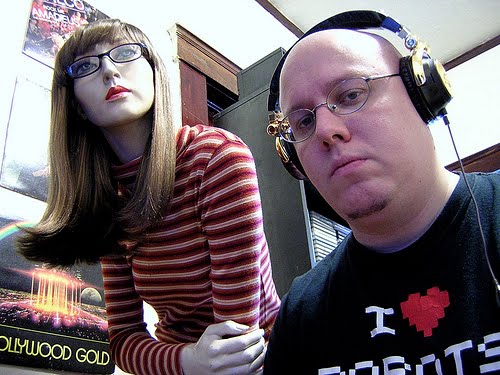
I owe at least two things to Michael Jackson. First, he made it okay for me to want to collect mannequins. "I imagine talking to them," he revealed to a Rolling Stone interviewer in 1982, describing the planned room in his new house that would be filled with showroom dummies. "I think I'm accompanying myself with friends I never had." The eccentric often compensates for a longing in the real world, a missing element that, for whatever reason, they are unable to adapt to socially. Even with millions of dollars and the respect and admiration of everyone from Andy Warhol to Ronald Reagan, Michael had to invent his best friends.
I could certainly relate as a child. I was no social butterfly; I preferred Encyclopedia Brown books and typing long, arduous lists of esoteric text into a new machine known as an "Apple IIe". I took apart tape recorders and tried to figure out how they worked, and recorded sounds backwards. I was fascinated by the birthing artform of rap music, and one of my most vivid childhood memories is my first attempt to "scratch" using my mother's copy of Thriller on my measly Fisher Price turntable.
That brings me to the second thing I owe Michael: he made it okay to want to be an artist. President Obama would have our children believe that thankless hard work and sucking up to the boss are the preferred methods of spending your time on Planet Earth. Michael, like Fred Rogers before him, told me that I was okay just the way I was. If I wanted to spend my days pecking out computer programs that made weird, bleepy noises, that wasn't merely not wrong; I was compelled to do so. Who I am and what I do are not separate entities.
If we take nothing else from Michael Jackson's life, let us for God's sake take that: it is your world. If it's miserable, you have no one to blame but you.
Today marks the one year anniversary of Jackson's death. I've been poking at this post since then, trying to get the words right, trying to explain how a man I never met could have such a profound impact on my small and measured life. The words do not come easy. As with many things esoteric, reason is only the beginning of wisdom; that which goes beyond is not explainable, not definable, not recordable.
But do I even need to? You were there in 1982; you wanted one of those damn ridiculous red zipper jackets so bad, because we all did. We wanted a piece of Michael because Michael was a piece of us; the unapologetic, empowered part we'd learned to push down so we could get through the day at school without being sent to the principal's office.
Don't push it down, said Michael. Let go of it. Let it run wild and free and touch the world with its beauty and joy. Let it shine like a beacon to the shore, showing the way to others who've become lost in the vast gray seas of mediocrity and hopelessness. Let them come to you and share in the joy; you are not alone; you are not alone.
If you look around
The whole world is coming together now
Feel it in the air
The wind is taking it everywhere
Can you feel it
Can you feel it
Can you feel it
Yes, God, yes, I can feel it. I can see inside the light that burns with the heat of a thousand suns. I see the grace and the beauty stirring, emanating from the deepest cockle of my breast, from the vantage point of my homunculus, and I will live in the light, I will know the light, and it will shine in glory for all the worlds.
I can feel it. I can hear the sound rumbling under the materia, the deepest bass of earthquakes and microwave bursts from quasars. I can hear the sound of the stars and the galaxies vibrating and spinning in their places like a giant watch, like the transmission of a humongous engine, and the sound comes bursting out of me.
I can feel it. I can feel the intense and all-pervading sincerity of compassion, of nonjudgmental caring, and it swarms over me like a sandstorm, like a hurricane of locusts. I can feel the warm winds of the scirocco eroding away the sarcasm and malice, time's steadfast chisel whittling away the impurities. I can feel the heat of the athenor, the alchemical furnace of searing light, burning away the hatred and the rage, reducing this bloated, sluggish body in fire and empathy like succulent broth from the blood of ruminants, until only the most beautiful, the most elegant parts remain, so forged in the blazes of love's relentless fire to serve forever, to offer myself for any and all uses, without precondition or complaint, to be one with the will of all, of every person, until I am nothing but an extension of every man and woman and child, until I have become all of their dreams, until I dissolve into the void of the universe, the fifth ring of Miyamoto Musashi, to see the Void as the Way, to see the Way as the Void.
I can feel it.
I can feel it.
I can feel it.
Dr. Rhythm blinked repeatedly. "Chisa, what the Hell am I looking at?"
"Don't you start," I said, adjusting the volume on the store stereo, which I had jerry-rigged into my laptop along with the advertising monitor from the lottery machine. "This is one of the greatest pieces of cinema ever made, and anyone who speaks ill of it will require a crowbar to extract my foot from their asshole." The screen, facing outwards towards the customers, was awash with colorful rainbow sparkles over footage of an adoring throng.
Kupo walked in, fresh from the plane trip, and grinned like a maniac as soon as he saw the screen. "Holy shit," he said, "where did you get a copy of this?"
"Had the missus torrent it for me," I replied. "Welcome to Tucson."
A regular customer, one of the hip kids that works at the local video store, came in behind Kupo, pausing and gawking as his eyes fell on the images. "I haven't seen this in ages!"
"Blame this guy," I said, pointing at Kupo. "He came all the way down from Baltimore to drive back with Dr. Rhythm. I figured the least I could do was make him feel at home."
"I do love me some Michael Jackson," said Kupo, still grinning.
We watched Moonwalker. It is, to put it mildly, an unusual work. The first third of the film is a retrospective of Jackson's early years, leading up through Thriller and Bad. At the second third, it becomes a compilation, with a new video remix of "Bad", the Claymation rendered "Speed Demon" and the collage art cum social critique of "Leave Me Alone." But it's the final third of the film that most people remember: a ridiculous, cinematographic epic wherein a mythological MJ archetype fights a Joe Pesci led laser-armed drug cartel by transforming into a panther, a car, a huge robot and finally a spaceship. And then he performs a cover of the Beatles' "Come Together" in a raunchy nightclub and Ladysmith Black Mambazo sings over the credits.
A large number of people cite this movie as the exact point that Michael Jackson lost his damned mind.
---
A recent article from BBC News cites scientific proof that there is a correlation between genius and schizophrenia. I hold all scientific studies in contempt as a general rule. Often the declarations should simply read: Study confirms that funder of study was correct; could be more correct with more money, say scientists. As I've noted at length elsewhere on this blog: if you want to change reality, paying for it is the easiest method.
Not all geniuses are insane, and not all insane people are geniuses -- unless you're willing to make the counterarguments that John Wayne Gacy was some sort of artistic visionary or that Stephen Hawking ought to be confined to a rubber room for his crazy-ass ideas about aliens and time travel. (Full disclosure: I actually do believe the latter one.) Nature doles out benefits as she may. Sometimes you get to be a genius; sometimes you die in childbirth. It's not fair, but we insist that it be, somehow, to salve our psychological inability to deal with existentialism. I'm pretty sure this is the evolutionary reason we have religion, too, but that's a subject for another time.
---
What is a subject for now, however, is the belief that Michael Jackson was a child molester. First of all -- let's not mince any words here -- no one, absolutely no one has made that charge stick. If we are a nation that believes in and even prides itself on the fairness of our justice system, then we shall not have the luxury of perjurious scandal in the wake of its verdicts. If anything, the lingering doubt we hold in regards to Jackson shows how vile and sordid we prefer our bias to be, damn the facts to the contrary.
We crave sensationalism and the breaking of scruples for the same reason we need mad geniuses: we, the public, are quite simply unable to take anything at face value. Consider the hoax that surrounded Fred Rogers during his life. Nefarious rumors spread that he always wore long-sleeved sweaters to hide the tattoos he got as a Navy SEAL sniper in Vietnam. Nevermind that Rogers, a nigh saintly man by all accounts, never served in the military in any capacity. We need Fred Rogers to be a bloodthirsty killing machine, because if there's one thing we can't stand, it's someone who doesn't have any vices.
That's why we need Michael to be a child fucker, too, but it goes deeper than that for Michael. He gets away with all the things we wish we could. He's weird, and cool, and effortless all at once. His innocence appeals to the child in us and his sexuality seduces the animal in us; to wit, he owns a zoo for the latter and an amusement park for the former. He's rich -- obscenely, distastefully rich on a level that nobody else in the world gets without brutally assfucking someone or another on the way up. He breaks the rules, then rewrites them, then breaks them again. He is a god among mortals. That's why we hate him so; that's why he must be destroyed.
We're a culture of victimization. We relish our horrible fuckups like badges of honor in an arena of pain and misery, and what we despise more than anything is to be reminded that we have the capacity to be better. If Michael Jackson isn't a monster, our whole matrix of defense mechanisms gets thrown into disarray -- because we'd be monsters in his position.
You want proof? How about the entire hierarchy of the Catholic church, who cover time and again for real child molesters? How about all those news stories of tragic fools who finally win the lottery after a lifetime of playing, only to blow the whole wad on hookers and cocaine within eighteen months? People say that power corrupts, but that's just another popular delusion to allow us to shuck our responsibilities. The maxim actually only works in reverse; we are born corrupt, and it's only our lack of power that keeps us from doing far more damage than we do already.
---
June 25, 2009, 3:30 PM MST
I called Dr. Rhythm. "How is Kupo taking this?"
"Considering, fairly well," he answered. "He's mostly in shock. He's been crying some."
"Get him back here immediately," I ordered. "He needs to be near someone who understands."
Kupo looked drained as he stumbled in, like he'd been without sleep for days. Bleary-eyed, he gazed at me with a quiet confusion. "How did you know? How did you know to have me out to Arizona on today of all days, to show me the Moonwalker video last night... how?"
"I don't know, Steve," I admitted. "Things like this happen to me occasionally. Four years ago I had a dream I killed Hunter Thompson, and he died three days later. Last year at this time I dreamed I had an argument with George Carlin that was so vicious I made him cry, and he died two days later. Synchronicity uses me as a focal point; I don't know why."
The answer seemed to satisfy him; he nodded simply, and sat down in the easy chair to watch the coverage on CNN. Dr. Rhythm, unsure of how to proceed, looked on apologetically.
---
Two things are interesting about Jacksons' death date. First, it happened on the date of the 25th anniversary of Purple Rain. I can only imagine Prince waking up to that on Thursday morning.
More interesting is the second coincidence: June 25th would be on the opposite side of the calendar from Christmas. Is it possible Jackson was the realization of the Second Coming? He exhibited many of the same characteristics as Christ. His flagrant defiance of gravity certainly made it appear that he could walk on water. Jackson implored us to look at the Man in the Mirror; Christ told us to take the logs out of our own eyes before criticizing the specks in others'. Obvious jokes aside, Michael did suffer the little children to come unto him. And both were men of peace whom you would never want to get into a brawl with, particularly if you happened to be a banker.
Some of Jesus's last words were "I will return as a thief in the night." You have to admit, when asked to envision what a robber looks like, most Americans would probably think of a black man.
---
I owe at least two things to Michael Jackson. First, he made it okay for me to want to collect mannequins. "I imagine talking to them," he revealed to a Rolling Stone interviewer in 1982, describing the planned room in his new house that would be filled with showroom dummies. "I think I'm accompanying myself with friends I never had." The eccentric often compensates for a longing in the real world, a missing element that, for whatever reason, they are unable to adapt to socially. Even with millions of dollars and the respect and admiration of everyone from Andy Warhol to Ronald Reagan, Michael had to invent his best friends.
I could certainly relate as a child. I was no social butterfly; I preferred Encyclopedia Brown books and typing long, arduous lists of esoteric text into a new machine known as an "Apple IIe". I took apart tape recorders and tried to figure out how they worked, and recorded sounds backwards. I was fascinated by the birthing artform of rap music, and one of my most vivid childhood memories is my first attempt to "scratch" using my mother's copy of Thriller on my measly Fisher Price turntable.
That brings me to the second thing I owe Michael: he made it okay to want to be an artist. President Obama would have our children believe that thankless hard work and sucking up to the boss are the preferred methods of spending your time on Planet Earth. Michael, like Fred Rogers before him, told me that I was okay just the way I was. If I wanted to spend my days pecking out computer programs that made weird, bleepy noises, that wasn't merely not wrong; I was compelled to do so. Who I am and what I do are not separate entities.
If we take nothing else from Michael Jackson's life, let us for God's sake take that: it is your world. If it's miserable, you have no one to blame but you.
---
Today marks the one year anniversary of Jackson's death. I've been poking at this post since then, trying to get the words right, trying to explain how a man I never met could have such a profound impact on my small and measured life. The words do not come easy. As with many things esoteric, reason is only the beginning of wisdom; that which goes beyond is not explainable, not definable, not recordable.
But do I even need to? You were there in 1982; you wanted one of those damn ridiculous red zipper jackets so bad, because we all did. We wanted a piece of Michael because Michael was a piece of us; the unapologetic, empowered part we'd learned to push down so we could get through the day at school without being sent to the principal's office.
Don't push it down, said Michael. Let go of it. Let it run wild and free and touch the world with its beauty and joy. Let it shine like a beacon to the shore, showing the way to others who've become lost in the vast gray seas of mediocrity and hopelessness. Let them come to you and share in the joy; you are not alone; you are not alone.
If you look around
The whole world is coming together now
Feel it in the air
The wind is taking it everywhere
Can you feel it
Can you feel it
Can you feel it
Yes, God, yes, I can feel it. I can see inside the light that burns with the heat of a thousand suns. I see the grace and the beauty stirring, emanating from the deepest cockle of my breast, from the vantage point of my homunculus, and I will live in the light, I will know the light, and it will shine in glory for all the worlds.
I can feel it. I can hear the sound rumbling under the materia, the deepest bass of earthquakes and microwave bursts from quasars. I can hear the sound of the stars and the galaxies vibrating and spinning in their places like a giant watch, like the transmission of a humongous engine, and the sound comes bursting out of me.
I can feel it. I can feel the intense and all-pervading sincerity of compassion, of nonjudgmental caring, and it swarms over me like a sandstorm, like a hurricane of locusts. I can feel the warm winds of the scirocco eroding away the sarcasm and malice, time's steadfast chisel whittling away the impurities. I can feel the heat of the athenor, the alchemical furnace of searing light, burning away the hatred and the rage, reducing this bloated, sluggish body in fire and empathy like succulent broth from the blood of ruminants, until only the most beautiful, the most elegant parts remain, so forged in the blazes of love's relentless fire to serve forever, to offer myself for any and all uses, without precondition or complaint, to be one with the will of all, of every person, until I am nothing but an extension of every man and woman and child, until I have become all of their dreams, until I dissolve into the void of the universe, the fifth ring of Miyamoto Musashi, to see the Void as the Way, to see the Way as the Void.
I can feel it.
I can feel it.
I can feel it.
Saturday, May 22, 2010
The Hurricane
There is no companionship with a fool; let a man walk alone, let him commit no sin, having few wishes, like an elephant in the forest.
-- the Dhammapada
I reached Tucson, Arizona on November 21st, 2004. A few days before my arrival, it began to rain. It rained for two whole months following; for the first time in decades, the water table broke even in the desert.
This would not be the first time I was introduced by precipitation. Almost a decade prior, I'd moved to Newark, Delaware on December 23rd, 1995. Three days later, the infamous Blizzard of '96 hit the town. A thousand stories have been told about this snowstorm; I could compile just the ones I've heard into a very successful book which would make Northern Exposure look like a sensible vacation slide show.
In the Book of the Subgenius, it says many times: the only way to get what you truly want is to give up entirely. I gave up on Newark. I took a train to Tucson, to live with some friends for a while. My new roommates were past generous; they were damn near saintly. In return, I shared what I had: Millennium Actress, Chrono Trigger, Threads. One weekend I told them of the genius of Crispin Glover, whose career they knew nothing of outside of Back to the Future. "You mean he sued Steven Spielberg and WON? That's AWESOME!"
"Yes, he's quite the self-made man. I'm eager to see his full-length film, What Is It, but it's extremely difficult to come by."
I began to acclimate to the desert. I spent time looking up venues in Arizona, ready to get on with performing music. In my various web searches I discovered Centennial Hall, an immense campus auditorium, and thought absently how great it would be to play such a large space, to cause an actual concert hall to resonate with my music.
Something was still missing.
I tried hanging out at local cafes; both Ike's and Safehouse were within walking distance. I ended up becoming more enamored with the free wifi than the local patrons, overhearing the same 'original ideas' again and again with each passing. This was no different from Newark; a glory-hole of self-deluded children, fashionably dressed, with a database of cultural inferences and not-too-weird tastes, lest the facade of faux nerdism pass into the genuine article.
With no small degree of despair, I realized I was getting too old for this shit.
Kupo's girlfriend popped on. "Do you have any interest in meeting people in Tucson?"
"Do I ever. What's up?"
"There's a friend on MOO who lives quite near you, by name of Kali. She's quite an interesting person, someone I think you'd get along with well. Would you like me to introduce you?"
"It certainly couldn't hurt. How do I get on this MOO? Is it like a MUD?"
"Same general principle. I'll help you through the registration process, but you can log on as a guest for now." She gave me the server address.
I set up a coffee date with Kali, at Ike's; she claimed she hated Safehouse, citing too much smoke and youth culture nonsense, which I could hardly argue. We talked for hours about music and art; it was evident that we would become fast friends. "I should introduce you to my friend Paul Miller sometime," she said at one point. "I think you'd both benefit from the mutual brain-picking."
I blinked twice. "The Paul Miller? As in, DJ Spooky?"
"The same. We've been friends for years; I met him through an afrofuturism forum. In fact, it's interesting that you both use afrofuturism in your art in distinct ways. With Team Techno, you and your bandmates have constructed a very African way of working -- call and response, chorus, syncopation and polyrhythms all play integral parts in the way you construct and perform music -- but of course you all have very European traditions, being of Caucasian heritage. With Spooky, the opposite is true: he forwards an African agenda using very European techniques." She paused, perhaps to let the ideas sink into me, or to herself. "Actually, I'd be interested in writing an academic piece about your band sometime."
I shrugged. "That's a flattering notion, but I'm not sure there's a band to write about anymore."
"What the fuck is this 'third Team Techno album' bullshit Bill is spouting?"
"Come on, Chisa. You know Bill: the eternal optimist. 'Where there's a will, there's a way...'"
"Where was that maxim when I was spending two years in Delaware, living with clinically insane roommates, in the middle of severe depression without medication, in a dead-end job, slugging through the worst post-breakup drama of my life? Would you care to show me where the fucking 'way' was that my Schopenhauer-like dedication of will was not able to produce? The notion of me ever coming back there to record an album with you two is so goddamn laughable, I ought to patent TCP-to-bitchslap technology in case you ever suggest something that idiotic again; it'd save me the hassle of all this typing, and let me cut to the chase of knocking some goddamn sense into your ass."
"Whatever, man. If you feel such a need to solder that door shut, that's your deal. I prefer to leave options open."
"Is that why, when I asked if you'd let me move into one of the five bedrooms in your house in Philly, three of which were unoccupied and rented for the specific purpose of having friends live with you, because I wanted to be near you and Bill and retain my sanity, you told me no, because your girlfriend wouldn't approve? Is that what you call 'leaving options open'?"
"Look, I'm sorry I can't perpetually bail you out, but sometimes I just can't accommodate your lifestyle choice. Here's a thought: how's about nigga gets a fucking job and his own place?"
"You've got a lot of damn nerve, son. Who held your sorry ass up when that same girlfriend dropped you on a whim? Bill, that's who -- you slept in his annex for a month! In contrast, I went through Hell with the Ex, and the nonsense with Baker being AWOL in New Orleans, and the heroin junkies and all the other fuckups in the Madison house, and I held a third shift job and did Team Techno. How about 'nigga' stops being a fucking hypocrite?"
"You did indeed have a tough time in Delaware that last year, and I did indeed move into that house with the intention of having friends live there, but it just didn't work out, for many different reasons. And now, I'm practically married..."
"Bill was literally married when you moved in with him! What kind of two-faced bullshit is this?"
"Call me what you will; I'm not responsible for anyone else's living situation but my own."
"That's a peculiar moralistic view from someone who's about to give birth to a child."
"You are not my son."
"No, but I did think I was your brother."
"I'm not your fucking keeper. Take care of your own shit, man!"
I paused, gazing at the words on the screen, mulling them over. "So that's how it is now? Are you sure you want to go down that road with me?"
"I can't deal with this shit right now. You are annoying the piss out of me." He logged off.
Time passed. Now-distant friends were tried and found wanting. Some left, never to return. Some just needed time to cool off.
I moved into Kali's studio for a bit, sensing my previous roommates needed their space back, in deference to their claims that I was not a burden. Kali essentially became my agent, helping me to set up shows and network with local contacts. Within a few months, I was standing on the stage at Centennial Hall. A few weeks after that, I was speaking directly to Crispin Glover, having just viewed What Is It in the Loft Cinema.
There was a noticeable turbulence to the air. I could sense the oncoming storm at the horizon.
"Hey," I said, peering over the 32-channel Behringer, "this is identical to the board I used to run for EIDE, at the East End back in Delaware."
"Really?" replied Gene. "You know, we don't exactly have a dedicated soundman. Would you be interested?"
I thought about it. "Hmm, maybe. I've got plenty of spare time on my hands; a hobby might be just what I need. And the notion of being the straight soundman in a nearly-all-queer choir tickles my irony bone."
Gene snickered. "Believe you me, I can relate. Well, I'll put a bug in the director's ear, see if we can't get you two chatting..."
A young black man approached cautiously, seeming a little shy. "And who might this be, Gene?"
"Oh! Jamal, this is Chisa, a friend who came out to watch us perform."
"Pleased to meet you," I said, shaking Jamal's hand.
"Did I hear you say something about Delaware? I wasn't trying to pry, but... I'm originally from Southeast Pennsylvania."
"Really! That's where I'm originally from as well. Whereabouts?"
"Oh, I grew up in I'd really like to fuck you, just South of Allentown."
I shook myself. Huh? "Er... Allentown, you say? I know that area. I was considering going to Lincoln Tech for electronics when I got out of high school."
"Well, isn't it a small world?" He smiled. "So what brings I hope you're gay like me to Arizona?"
Kali came up from behind me. "I'm sorry if I'm interrupting, but were we going to get lunch together, Chisa? We'd better go now or we'll miss the start of the concert."
"Ah, yes," I said. "It was nice meeting you, Jamal." I nodded politely to he and Gene, then walked off with Kali.
"I think that guy was hitting on me," I concluded, finally.
"What do you mean, 'you think?' He most certain was." Kali sipped at her chai.
"Well, I've never really received a signal like that before."
"Ever?" She looked astonished.
"I'm sure that sounds weird, but yes, I can honestly say I've never been able to tell the difference between my own wishful thinking and someone actually making a pass at me. Rather than risk the misinterpretation, I gave up trying and just assumed no one ever was, but just then, it was damn near like telepathy."
Kali shook her head. "Unfathomable," she said, reaching for the ketchup, a brassy glint of sunlight catching her ring.
"Hey," I said, leaning closer, "that's neat. Where'd you get that?"
Kali blinked, then smiled. "Ah, now it makes sense. You've never seen this before, have you?"
"It's the first time I've ever seen it."
"Well, it's been on my finger since I've met you. I've been wearing this ring for years; I never take it off." She extended her finger; the Medusa-head emblem radiated ancient power. It looked like a molding from the Roman Empire, and may very well have been. "It's old -- older than I care to think about. It reveals itself to people when it wants to. Today was apparently a very special day."
I sighed. "You know, your mystical artifacts are really beginning to piss me off. Bad enough that you left that voodoo blood ritual nonsense going in your studio when you went out hiking the Grand Canyon. I was shaken for weeks after that dream where I killed Hunter Thompson."
"It was only a dream."
"He died three days later."
She laughed. "New topic, then: when are you going to start deejaying on the MOO?"
"I can't very well stream audio with a dead laptop." My beloved Toshiba had shit the bed a few weeks prior, the power connector on its motherboard blown out from capacitor plague.
"You could always use my iBook."
"You know I despise Macs. As soon as Kupo ships my desktop from Baltimore, I'll get on. Who'd you say I'd have to talk to?"
"Her name is Muggy."
I was familiar with text-based environments like the MOO, having spent quite a lot of time on MUSHes and MUCKs in the mid-90s. It didn't take me long to learn both the basics of its system syntax and the peculiarities of its social lattice.
Muggy ran a room on the MOO, which was fairly popular for that server. I logged on and teleported my character there. "Kali says you're the one I need to talk to about doing the radio stream?"
"Wheee!" said Muggy. "Yeah, it's this new thing I've just set up recently. You know how to do Icecast?"
"Most of my streaming experience is with Shoutcast, but as I understand it's the same basic principal, and uses the same tools."
"Let me set you up with a login," she said. As she worked on allowing me access in another window, I typed a look command on her character, curious as to how she'd described herself:
Spawn of William S Burroughs, naked, sucking translucent, colored syrups through Welcome, Chisa of Team Techno. purple-blue lips cover a razor-sharp beak of I have been waiting for one such as you for a very long time now. secretes an addicting fluid from her Listen carefully: here are the songs you must play for me...
The words on the screen may as well have been invisible; the true message was hidden inside them, like a television signal in a carrier wave. I shook myself, dazed by their power. It was a far more potent signal than I'd gotten from Jamal, a directive akin to those heard by Elijah and Abraham.
"Okay," she said, "You're ready to go, check your MOOmail for the password."
"Solid," I said. "When would you like me to go?"
"No time like the present," she said.
"Right now? I thought you were on."
"Oh, that's just an automated playlist. I can kick it off whenever. Saddle up!"
I nodded, logging my Winamp plugin into the server and routing the audio from Virtual Turntables to the input. After a brief perusal of my mp3s, I opened with something from a DJ Spooky album:
I've got two turntables and Coltrane
And not just blue Coltrane
And not just Monk, and not just Miles
I got a million musicians playin' over my head
A band of angels responding to the percussion of stomps and hollers
Heads don't even know what's happening to 'em
They just know something's happening to 'em
Song blended into song without audible break, each addition to the setlist crafting a new chapter in the story. Boards of Canada morphed into Steve Miller; Future Sound of London gave way to Palace Brothers; Tears For Fears engaged Telefon Tel Aviv. Faraway, in Chattanooga, the atmospheric disturbance charged the air with its haunting sound.
"I ain't never seen nothin' like you before," said Muggy, her Southern drawl coming clearly through the text, punctuated by an equally clear eyebrow raise.
"I found a place to live."
"Splendid!" Kali smiled. "Where?"
"Tennessee."
The smile gave way to incredulous shock. "Okay," she said after a moment of self-composure, "because I'm your friend, I have to tell you I think this is a bad idea. You're moving way too fast with Muggy, and this is an incredibly rash decision."
I nodded. "Opinion noted and filed. You are pre-approved for one 'I told you so' should anything go horribly wrong."
"When do you leave?"
"Independence Day. Assuming everything goes without a hitch -- which it won't, seeing as I'll have to go through New Orleans, and something always goes awry whenever I have to deal with New Orleans -- she'll be picking me up in Atlanta on my birthday, since there's no Amtrak line to Chattanooga.
"Interesting. There is in fact no such thing as a Chattanooga choo-choo." There was a knock at the door. Kali got up to answer it; the UPS man was on the other side. "It's for you," she said, perusing the label on the package.
"Ah, that must be the laptop. An online friend had an extra lying around, and generously donated it so I could check in with wifi at the terminals on the trip." I took an exacto to the seals, digging through the styrofoam peanuts until the contents were revealed. A grimace overtook my face.
"What's the matter?" asked Kali.
I reached into the box and pulled out a Mac. Kali burst into laughter.
"I'm very sorry, sir, but all routes have been annulled for today due to Tropical Storm Cindy. You see, the dam is currently open, to keep the river from back-flowing into the city, and the wash goes straight over the tracks."
"So I'm stuck here for a day, then?"
"It appears that way. The next available train is tomorrow, same time as the one you would have been on today."
I was exhausted from two days of sleeplessness. On the Silver Meteor, I was plagued by a little shit whose mother obviously never give him enough attention. He could only talk in a loud bark, and made it his personal mission to wake me up wherever I decided to catch a nap; the demon even found me when I hid behind stacks of suitcases in the baggage car. The Ambien and Ultracet I'd acquired only compounded matters; I was like a zombie on the sleep aids and painkillers, a drained corpse deprived of its final rest. It took all my remaining strength not to take my frustration out on the poor ticketer. "Fine, then. Swap me out, I'll take tomorrow's train."
"Very good, sir." He took my old ticket and presented me with a near-identical one, the only difference being the departure date: July 7.
I trudged back to the Meteor; it was docked there for a day, unable to return to its home, and the conductors had left it open for the stranded travelers to use. I retired to the cafe car; no one was there, and only a few remaining stragglers slumbered in the observation deck above. I set up an impromptu apartment in the unused space, washing myself in the lavatory. I tried to write for a bit on the iBook, but could not; I tried to sleep, but could not. Outside the station, Cindy raged against New Orleans, mocking me, keeping me from my destination on my own damn birthday.
I donned my Gore-Tex jacket, which had been nearly useless in Arizona, and packed up my belongings. Inside Union Station, I chose a terminal locker and secured my bags. Then I went outside, to the emptied night city, to confront Cindy.
She whined like a thousand-foot organ grinder through the darkened skyscrapers of Poydras and Loyola. Blankets of rain came at me like fishing nets, the likes of which I hadn't seen since my summer on Long Beach Island. I persisted through, nigh-crazed on sleeplessness and adrenaline.
Above me, a gust so fierce that it appeared solid broke away a tree branch the size of a car bumper. It soared through the air, sailing two feet above my head.
"I am the True Hurricane!" I declared defiantly to the sky. "Disperse your false ass right now!"
I stood my ground. Slowly, the winds died down, defeated.
I walked back to Union Station and slept soundly on a Greyhound bench.
It was an instant message long coming, and worth the wait: "I need your help."
"Oho! Cain summons his brother back from the dead! How fares the land of Nod, old pal o' mine?"
"Look, Bill and I have been working on the art for the second album, but you know neither one of us is the Photoshop Senior that you are..."
I stopped him in mid-sentence. "You know, my inbox is full of a LOT of spam today. And it appears to me, that most of it is being auto-forwarded from a particular array of addresses that YOU set up. And if memory serves, I asked you to turn said auto-forwarding off something like a year and a half ago."
"Chisa..."
"I'm just not sure I can free up any time to take care of your shit, man. You know how it is."
Ten minutes passed.
"Alright, it's fixed."
"Splendid. Now what was it you needed me to do? I seem to have an opening in my schedule this afternoon."
"Everything seems to have turned out right in the end."
"Except for Hologram," I said. "I would have liked to make it up to Philly for that. Can you imagine their faces? I can just hear Chronkite now: '...and would you believe after all this shit, the bastard shows up with a fucking Mac and just plugs right in! The absolute audacity.'" I paused. "It would have been been perfect, you know? Just perfect."
She leaned towards me, the cold of tarnished brass hitting my chest.
I looked down, surprised. "Where did you get that?"
Muggy smiled. "It's from the cuckoo clock, up there on the mantle. I think it's an appropriate talisman." She held it up for me to see; a simple chain harnessed the key around her neck.
"You've been researching my fetish," I mused. I grasped it between my fingers, rubbed it like a good luck coin, felt the history of clocks and mechanisms in it's metal, felt the excitement of sex in the promises of its presence.
I twirl it around in my fingers, winding an imaginary shaft in the air. The key dances under my fingers, turns and keeps things moving. Outside the door I hear the ambiance of Front Street, a short walk from the East End Cafe, where I am holding EIDE every Monday night. Outside the window I hear the Atlantic Ocean and Barnegat Bay, mere blocks from my third story bedroom on Long Beach Island. I hear Kupo composing in his Baltimore basement, dark and cold and full of memory; the loft above Safehouse, fog-smoky and resonating with the frequency of overlapping conversation; my childhood room in Prospect Park, with my old Timex Sinclair 1000 running 2K BASIC programs.
I'm walking station to station like David Bowie, at once in Emeryville, in Chicago, at 30th Street in Philly (twice), at Union Station in New Orleans (twice), in the possible fractal futures of Cape Cod and San Diego and Detroit separated by the thinnest quantum membrane, space guitars rippling through time like caramel in a sundae:
I went from Phoenix, Arizona
All the way to Tacoma
Philadelphia, Atlanta, L.A.
Northern California, where the girls are warm
So I could hear my sweet baby say
Keep on rockin' me, baby
Keep on rockin' me, baby
I turn the key, winding the clockwork tension to full, and then release, the mainspring spiraling slowly outwards like a hurricane.
-- the Dhammapada
I reached Tucson, Arizona on November 21st, 2004. A few days before my arrival, it began to rain. It rained for two whole months following; for the first time in decades, the water table broke even in the desert.
This would not be the first time I was introduced by precipitation. Almost a decade prior, I'd moved to Newark, Delaware on December 23rd, 1995. Three days later, the infamous Blizzard of '96 hit the town. A thousand stories have been told about this snowstorm; I could compile just the ones I've heard into a very successful book which would make Northern Exposure look like a sensible vacation slide show.
In the Book of the Subgenius, it says many times: the only way to get what you truly want is to give up entirely. I gave up on Newark. I took a train to Tucson, to live with some friends for a while. My new roommates were past generous; they were damn near saintly. In return, I shared what I had: Millennium Actress, Chrono Trigger, Threads. One weekend I told them of the genius of Crispin Glover, whose career they knew nothing of outside of Back to the Future. "You mean he sued Steven Spielberg and WON? That's AWESOME!"
"Yes, he's quite the self-made man. I'm eager to see his full-length film, What Is It, but it's extremely difficult to come by."
I began to acclimate to the desert. I spent time looking up venues in Arizona, ready to get on with performing music. In my various web searches I discovered Centennial Hall, an immense campus auditorium, and thought absently how great it would be to play such a large space, to cause an actual concert hall to resonate with my music.
Something was still missing.
I tried hanging out at local cafes; both Ike's and Safehouse were within walking distance. I ended up becoming more enamored with the free wifi than the local patrons, overhearing the same 'original ideas' again and again with each passing. This was no different from Newark; a glory-hole of self-deluded children, fashionably dressed, with a database of cultural inferences and not-too-weird tastes, lest the facade of faux nerdism pass into the genuine article.
With no small degree of despair, I realized I was getting too old for this shit.
---
Kupo's girlfriend popped on. "Do you have any interest in meeting people in Tucson?"
"Do I ever. What's up?"
"There's a friend on MOO who lives quite near you, by name of Kali. She's quite an interesting person, someone I think you'd get along with well. Would you like me to introduce you?"
"It certainly couldn't hurt. How do I get on this MOO? Is it like a MUD?"
"Same general principle. I'll help you through the registration process, but you can log on as a guest for now." She gave me the server address.
I set up a coffee date with Kali, at Ike's; she claimed she hated Safehouse, citing too much smoke and youth culture nonsense, which I could hardly argue. We talked for hours about music and art; it was evident that we would become fast friends. "I should introduce you to my friend Paul Miller sometime," she said at one point. "I think you'd both benefit from the mutual brain-picking."
I blinked twice. "The Paul Miller? As in, DJ Spooky?"
"The same. We've been friends for years; I met him through an afrofuturism forum. In fact, it's interesting that you both use afrofuturism in your art in distinct ways. With Team Techno, you and your bandmates have constructed a very African way of working -- call and response, chorus, syncopation and polyrhythms all play integral parts in the way you construct and perform music -- but of course you all have very European traditions, being of Caucasian heritage. With Spooky, the opposite is true: he forwards an African agenda using very European techniques." She paused, perhaps to let the ideas sink into me, or to herself. "Actually, I'd be interested in writing an academic piece about your band sometime."
I shrugged. "That's a flattering notion, but I'm not sure there's a band to write about anymore."
---
"What the fuck is this 'third Team Techno album' bullshit Bill is spouting?"
"Come on, Chisa. You know Bill: the eternal optimist. 'Where there's a will, there's a way...'"
"Where was that maxim when I was spending two years in Delaware, living with clinically insane roommates, in the middle of severe depression without medication, in a dead-end job, slugging through the worst post-breakup drama of my life? Would you care to show me where the fucking 'way' was that my Schopenhauer-like dedication of will was not able to produce? The notion of me ever coming back there to record an album with you two is so goddamn laughable, I ought to patent TCP-to-bitchslap technology in case you ever suggest something that idiotic again; it'd save me the hassle of all this typing, and let me cut to the chase of knocking some goddamn sense into your ass."
"Whatever, man. If you feel such a need to solder that door shut, that's your deal. I prefer to leave options open."
"Is that why, when I asked if you'd let me move into one of the five bedrooms in your house in Philly, three of which were unoccupied and rented for the specific purpose of having friends live with you, because I wanted to be near you and Bill and retain my sanity, you told me no, because your girlfriend wouldn't approve? Is that what you call 'leaving options open'?"
"Look, I'm sorry I can't perpetually bail you out, but sometimes I just can't accommodate your lifestyle choice. Here's a thought: how's about nigga gets a fucking job and his own place?"
"You've got a lot of damn nerve, son. Who held your sorry ass up when that same girlfriend dropped you on a whim? Bill, that's who -- you slept in his annex for a month! In contrast, I went through Hell with the Ex, and the nonsense with Baker being AWOL in New Orleans, and the heroin junkies and all the other fuckups in the Madison house, and I held a third shift job and did Team Techno. How about 'nigga' stops being a fucking hypocrite?"
"You did indeed have a tough time in Delaware that last year, and I did indeed move into that house with the intention of having friends live there, but it just didn't work out, for many different reasons. And now, I'm practically married..."
"Bill was literally married when you moved in with him! What kind of two-faced bullshit is this?"
"Call me what you will; I'm not responsible for anyone else's living situation but my own."
"That's a peculiar moralistic view from someone who's about to give birth to a child."
"You are not my son."
"No, but I did think I was your brother."
"I'm not your fucking keeper. Take care of your own shit, man!"
I paused, gazing at the words on the screen, mulling them over. "So that's how it is now? Are you sure you want to go down that road with me?"
"I can't deal with this shit right now. You are annoying the piss out of me." He logged off.
---
Time passed. Now-distant friends were tried and found wanting. Some left, never to return. Some just needed time to cool off.
I moved into Kali's studio for a bit, sensing my previous roommates needed their space back, in deference to their claims that I was not a burden. Kali essentially became my agent, helping me to set up shows and network with local contacts. Within a few months, I was standing on the stage at Centennial Hall. A few weeks after that, I was speaking directly to Crispin Glover, having just viewed What Is It in the Loft Cinema.
There was a noticeable turbulence to the air. I could sense the oncoming storm at the horizon.
---
"Hey," I said, peering over the 32-channel Behringer, "this is identical to the board I used to run for EIDE, at the East End back in Delaware."
"Really?" replied Gene. "You know, we don't exactly have a dedicated soundman. Would you be interested?"
I thought about it. "Hmm, maybe. I've got plenty of spare time on my hands; a hobby might be just what I need. And the notion of being the straight soundman in a nearly-all-queer choir tickles my irony bone."
Gene snickered. "Believe you me, I can relate. Well, I'll put a bug in the director's ear, see if we can't get you two chatting..."
A young black man approached cautiously, seeming a little shy. "And who might this be, Gene?"
"Oh! Jamal, this is Chisa, a friend who came out to watch us perform."
"Pleased to meet you," I said, shaking Jamal's hand.
"Did I hear you say something about Delaware? I wasn't trying to pry, but... I'm originally from Southeast Pennsylvania."
"Really! That's where I'm originally from as well. Whereabouts?"
"Oh, I grew up in I'd really like to fuck you, just South of Allentown."
I shook myself. Huh? "Er... Allentown, you say? I know that area. I was considering going to Lincoln Tech for electronics when I got out of high school."
"Well, isn't it a small world?" He smiled. "So what brings I hope you're gay like me to Arizona?"
Kali came up from behind me. "I'm sorry if I'm interrupting, but were we going to get lunch together, Chisa? We'd better go now or we'll miss the start of the concert."
"Ah, yes," I said. "It was nice meeting you, Jamal." I nodded politely to he and Gene, then walked off with Kali.
---
"I think that guy was hitting on me," I concluded, finally.
"What do you mean, 'you think?' He most certain was." Kali sipped at her chai.
"Well, I've never really received a signal like that before."
"Ever?" She looked astonished.
"I'm sure that sounds weird, but yes, I can honestly say I've never been able to tell the difference between my own wishful thinking and someone actually making a pass at me. Rather than risk the misinterpretation, I gave up trying and just assumed no one ever was, but just then, it was damn near like telepathy."
Kali shook her head. "Unfathomable," she said, reaching for the ketchup, a brassy glint of sunlight catching her ring.
"Hey," I said, leaning closer, "that's neat. Where'd you get that?"
Kali blinked, then smiled. "Ah, now it makes sense. You've never seen this before, have you?"
"It's the first time I've ever seen it."
"Well, it's been on my finger since I've met you. I've been wearing this ring for years; I never take it off." She extended her finger; the Medusa-head emblem radiated ancient power. It looked like a molding from the Roman Empire, and may very well have been. "It's old -- older than I care to think about. It reveals itself to people when it wants to. Today was apparently a very special day."
I sighed. "You know, your mystical artifacts are really beginning to piss me off. Bad enough that you left that voodoo blood ritual nonsense going in your studio when you went out hiking the Grand Canyon. I was shaken for weeks after that dream where I killed Hunter Thompson."
"It was only a dream."
"He died three days later."
She laughed. "New topic, then: when are you going to start deejaying on the MOO?"
"I can't very well stream audio with a dead laptop." My beloved Toshiba had shit the bed a few weeks prior, the power connector on its motherboard blown out from capacitor plague.
"You could always use my iBook."
"You know I despise Macs. As soon as Kupo ships my desktop from Baltimore, I'll get on. Who'd you say I'd have to talk to?"
"Her name is Muggy."
---
I was familiar with text-based environments like the MOO, having spent quite a lot of time on MUSHes and MUCKs in the mid-90s. It didn't take me long to learn both the basics of its system syntax and the peculiarities of its social lattice.
Muggy ran a room on the MOO, which was fairly popular for that server. I logged on and teleported my character there. "Kali says you're the one I need to talk to about doing the radio stream?"
"Wheee!" said Muggy. "Yeah, it's this new thing I've just set up recently. You know how to do Icecast?"
"Most of my streaming experience is with Shoutcast, but as I understand it's the same basic principal, and uses the same tools."
"Let me set you up with a login," she said. As she worked on allowing me access in another window, I typed a look command on her character, curious as to how she'd described herself:
Spawn of William S Burroughs, naked, sucking translucent, colored syrups through Welcome, Chisa of Team Techno. purple-blue lips cover a razor-sharp beak of I have been waiting for one such as you for a very long time now. secretes an addicting fluid from her Listen carefully: here are the songs you must play for me...
The words on the screen may as well have been invisible; the true message was hidden inside them, like a television signal in a carrier wave. I shook myself, dazed by their power. It was a far more potent signal than I'd gotten from Jamal, a directive akin to those heard by Elijah and Abraham.
"Okay," she said, "You're ready to go, check your MOOmail for the password."
"Solid," I said. "When would you like me to go?"
"No time like the present," she said.
"Right now? I thought you were on."
"Oh, that's just an automated playlist. I can kick it off whenever. Saddle up!"
I nodded, logging my Winamp plugin into the server and routing the audio from Virtual Turntables to the input. After a brief perusal of my mp3s, I opened with something from a DJ Spooky album:
I've got two turntables and Coltrane
And not just blue Coltrane
And not just Monk, and not just Miles
I got a million musicians playin' over my head
A band of angels responding to the percussion of stomps and hollers
Heads don't even know what's happening to 'em
They just know something's happening to 'em
Song blended into song without audible break, each addition to the setlist crafting a new chapter in the story. Boards of Canada morphed into Steve Miller; Future Sound of London gave way to Palace Brothers; Tears For Fears engaged Telefon Tel Aviv. Faraway, in Chattanooga, the atmospheric disturbance charged the air with its haunting sound.
"I ain't never seen nothin' like you before," said Muggy, her Southern drawl coming clearly through the text, punctuated by an equally clear eyebrow raise.
---
"I found a place to live."
"Splendid!" Kali smiled. "Where?"
"Tennessee."
The smile gave way to incredulous shock. "Okay," she said after a moment of self-composure, "because I'm your friend, I have to tell you I think this is a bad idea. You're moving way too fast with Muggy, and this is an incredibly rash decision."
I nodded. "Opinion noted and filed. You are pre-approved for one 'I told you so' should anything go horribly wrong."
"When do you leave?"
"Independence Day. Assuming everything goes without a hitch -- which it won't, seeing as I'll have to go through New Orleans, and something always goes awry whenever I have to deal with New Orleans -- she'll be picking me up in Atlanta on my birthday, since there's no Amtrak line to Chattanooga.
"Interesting. There is in fact no such thing as a Chattanooga choo-choo." There was a knock at the door. Kali got up to answer it; the UPS man was on the other side. "It's for you," she said, perusing the label on the package.
"Ah, that must be the laptop. An online friend had an extra lying around, and generously donated it so I could check in with wifi at the terminals on the trip." I took an exacto to the seals, digging through the styrofoam peanuts until the contents were revealed. A grimace overtook my face.
"What's the matter?" asked Kali.
I reached into the box and pulled out a Mac. Kali burst into laughter.
---
"I'm very sorry, sir, but all routes have been annulled for today due to Tropical Storm Cindy. You see, the dam is currently open, to keep the river from back-flowing into the city, and the wash goes straight over the tracks."
"So I'm stuck here for a day, then?"
"It appears that way. The next available train is tomorrow, same time as the one you would have been on today."
I was exhausted from two days of sleeplessness. On the Silver Meteor, I was plagued by a little shit whose mother obviously never give him enough attention. He could only talk in a loud bark, and made it his personal mission to wake me up wherever I decided to catch a nap; the demon even found me when I hid behind stacks of suitcases in the baggage car. The Ambien and Ultracet I'd acquired only compounded matters; I was like a zombie on the sleep aids and painkillers, a drained corpse deprived of its final rest. It took all my remaining strength not to take my frustration out on the poor ticketer. "Fine, then. Swap me out, I'll take tomorrow's train."
"Very good, sir." He took my old ticket and presented me with a near-identical one, the only difference being the departure date: July 7.
I trudged back to the Meteor; it was docked there for a day, unable to return to its home, and the conductors had left it open for the stranded travelers to use. I retired to the cafe car; no one was there, and only a few remaining stragglers slumbered in the observation deck above. I set up an impromptu apartment in the unused space, washing myself in the lavatory. I tried to write for a bit on the iBook, but could not; I tried to sleep, but could not. Outside the station, Cindy raged against New Orleans, mocking me, keeping me from my destination on my own damn birthday.
I donned my Gore-Tex jacket, which had been nearly useless in Arizona, and packed up my belongings. Inside Union Station, I chose a terminal locker and secured my bags. Then I went outside, to the emptied night city, to confront Cindy.
She whined like a thousand-foot organ grinder through the darkened skyscrapers of Poydras and Loyola. Blankets of rain came at me like fishing nets, the likes of which I hadn't seen since my summer on Long Beach Island. I persisted through, nigh-crazed on sleeplessness and adrenaline.
Above me, a gust so fierce that it appeared solid broke away a tree branch the size of a car bumper. It soared through the air, sailing two feet above my head.
"I am the True Hurricane!" I declared defiantly to the sky. "Disperse your false ass right now!"
I stood my ground. Slowly, the winds died down, defeated.
I walked back to Union Station and slept soundly on a Greyhound bench.
---
It was an instant message long coming, and worth the wait: "I need your help."
"Oho! Cain summons his brother back from the dead! How fares the land of Nod, old pal o' mine?"
"Look, Bill and I have been working on the art for the second album, but you know neither one of us is the Photoshop Senior that you are..."
I stopped him in mid-sentence. "You know, my inbox is full of a LOT of spam today. And it appears to me, that most of it is being auto-forwarded from a particular array of addresses that YOU set up. And if memory serves, I asked you to turn said auto-forwarding off something like a year and a half ago."
"Chisa..."
"I'm just not sure I can free up any time to take care of your shit, man. You know how it is."
Ten minutes passed.
"Alright, it's fixed."
"Splendid. Now what was it you needed me to do? I seem to have an opening in my schedule this afternoon."
---
"Everything seems to have turned out right in the end."
"Except for Hologram," I said. "I would have liked to make it up to Philly for that. Can you imagine their faces? I can just hear Chronkite now: '...and would you believe after all this shit, the bastard shows up with a fucking Mac and just plugs right in! The absolute audacity.'" I paused. "It would have been been perfect, you know? Just perfect."
She leaned towards me, the cold of tarnished brass hitting my chest.
I looked down, surprised. "Where did you get that?"
Muggy smiled. "It's from the cuckoo clock, up there on the mantle. I think it's an appropriate talisman." She held it up for me to see; a simple chain harnessed the key around her neck.
"You've been researching my fetish," I mused. I grasped it between my fingers, rubbed it like a good luck coin, felt the history of clocks and mechanisms in it's metal, felt the excitement of sex in the promises of its presence.
I twirl it around in my fingers, winding an imaginary shaft in the air. The key dances under my fingers, turns and keeps things moving. Outside the door I hear the ambiance of Front Street, a short walk from the East End Cafe, where I am holding EIDE every Monday night. Outside the window I hear the Atlantic Ocean and Barnegat Bay, mere blocks from my third story bedroom on Long Beach Island. I hear Kupo composing in his Baltimore basement, dark and cold and full of memory; the loft above Safehouse, fog-smoky and resonating with the frequency of overlapping conversation; my childhood room in Prospect Park, with my old Timex Sinclair 1000 running 2K BASIC programs.
I'm walking station to station like David Bowie, at once in Emeryville, in Chicago, at 30th Street in Philly (twice), at Union Station in New Orleans (twice), in the possible fractal futures of Cape Cod and San Diego and Detroit separated by the thinnest quantum membrane, space guitars rippling through time like caramel in a sundae:
I went from Phoenix, Arizona
All the way to Tacoma
Philadelphia, Atlanta, L.A.
Northern California, where the girls are warm
So I could hear my sweet baby say
Keep on rockin' me, baby
Keep on rockin' me, baby
I turn the key, winding the clockwork tension to full, and then release, the mainspring spiraling slowly outwards like a hurricane.
Thursday, April 15, 2010
Wings' "Let 'Em In," Translated for Literature Majors
Here is a list of people attempting entry to our abode.
Allow them.
Allow them.
Saturday, September 26, 2009
Why Video Games Are Making Films Obsolete (But Not Books)
I've never been a particularly big fan of movies. Sure, I have a few favorites from over the three and a half decades of my life, but I've also seen far less than your average person. Indeed, people are often shocked when they hear some of the movies I have not seen (included on that list: Akira, The Godfather, The Shawshank Redemption, The Princess Bride, The Goonies). Furthermore, most of the ones I have seen have been via television (in the forms of VHS, DVD or cable), whose tortured, senile death throes I have already discussed at length elsewhere on this blog.
The movie house, like the stage theater, is a dying space. Certainly it will always have its aficionados, but its usefulness as a provider of social memes and connecting experiences is decreasing every year. For starters, people have more options for experiencing film due to increased and increasing technological freedoms. No longer must the blockbuster movie come with the implied agreement of noisy audiences, gumshoe aisles, a ten-dollar ticket price and thirty minutes of commercials. Indeed, some filmmakers are now choosing to release DVD and online streaming version of their films concurrent with the "proper" theatrical release. The reasoning is simple: people want control of their media.
And that is exactly the reason why films are becoming obsolete, while their red-headed stepchild, video games, becomes more and more engaging. Films strip much of the control mechanism away from media by their very design. It's only now, faced with the extinction of their entire distribution network, that studios even allow for such alternate means of viewing experience. Films are passive, while video games (and, oddly enough, books, the precursor to film in the realm of narrative delivery) are interactive.
Wait, what? Did I just say that books are more interactive than films? I did. It's one of the many ways in which literature is superior to the cinema as a vessel for storytelling, and since you're clearly incredulous now, I'll explain why.
Books allow the reader control over the environment. When you read a book, you envision how the characters look based on the descriptions provided by the author. You envision how buildings, stretches of land, entire planets look via the author's cues -- but that is your envisioning. It's different from everyone else who reads the book. Until Lord of the Rings was a series of Peter Jackson films, no two people thought of Frodo as looking the same; of course, now that film has tainted our collective social consciousness, it's almost impossible to think of him as not looking like Elijah Wood. Film takes away your ability to create the environment for a narrative. (I've discussed that at length before, too.)
In contrast, a video game provides a fully-rendered environment, but gives you control of the action. In a video game, you control the character's path. The narrative is one that you provide yourself, choosing which direction to go next, which challenges to surmount. Many video games do indeed lead the player into a simplistic, linear path, but even those that do never play the game for you. Film does exactly that. In film, the viewer has neither control of the action nor the environment. The control mechanism is removed entirely, providing a purely passive experience.
Timing is another element of control that film robs from the viewer. In a book, you can linger on a page, a paragraph, or a sentence as long as you like, savoring the emotion of the moment that the words provide you. In a video game, you control the rate at which the character progresses, both in a literal and metaphorical sense; even games with a level timer do not ensure that you will use the exact amount of seconds to reach the end of the stage. But in film, timing is everything. Shots are timed to convey the performance required by the director. Cuts are editted to maximize the flow of the story by the producer. Films rarely escape the two-hour Golden Rule, which itself is timed so as not to risk conflicting with our biological clocks, since no one wants to go to the restroom in the middle of a film. Even the release of films is timed to meet up with summer movie habits or Oscar nominations; television does this too, with its tried-and-true "tune in next week" format to keep us coming back to the screen every week at the same hour.
All of these variables point to a very interesting trend: people are now deciding that they want control of their experiences. They no longer desire to be stuffed into a train car and taken, blindfolded, to their destination. They want to enjoy the journey; they want to conduct the train. This is exhibited in other forms of modern art as well, music being the immediate example. Mash-ups, covers and sampling have become commonplace. The line between producer and listener blurs more by the day. Bedroom composers create songs to rival the professionals; Jonathon Coulton, Owl City and Lady Wallace all have followings as large as any fly-by-night pop icon. Again, the reason is that technology is now so cheap and ubiquitous that the tools for anyone to become an auteur are readily available.
This points us to the other prevailing reason that film is going to die: it takes much more money to make a movie or a television show than it does to make a book or a video game. A-list stars, Redrock depth-of-field adapters, over-the-top CGI rendering, on-location site licensing, endless legions of producers and co-producers and executive producers -- all the things required to make a film add up to hundreds of millions of dollars. No book or video game has ever cost so much, though video games are getting close these days; Grand Theft Auto IV cost a whopping one hundred million to make, but that's an extreme exception, and on average a current generation console game costs about fifteen million, which is still nowhere near movie budgets. (For comparison, a hundred million in Hollywood will get you The Adventures of Pluto Nash.) Novels, it almost goes without saying, come nowhere near these costs; putting words on a page will set you back maybe a five thousand dollar investment.
What we have, then, is an entertainment industry which firstly costs more than any other to maintain, and secondly is no longer able to deliver the demands of its target audience. This is an equation for bankruptcy. Most damning of all is that the industry knows this; even Speilberg, Hollywood's messiah, is dumping buckets of money into exploring new options in 3D technology, just to keep his floundering artform fresh.
I do like film. I've gotten a number of grand experiences out of the medium of cinema. I can't, however, look the other way as that medium continues to vaunt itself as the arbiter of culture, when it is clear to me that its authority in such matters has become dubious and suspect.
Once, when I was visiting my mother, I found that her computer had a DVD playing program that would increase or decrease the speed of a film while keeping the audio the correct pitch; you could take a movie up to two hundred percent of its original speed without making the actors sound like chipmunks. Amused by the possibilities, I immediately decided to watch Star Wars Episode Two: Attack Of The Clones. At its normal speed, the bloated epic seemed merely forced and pompous; compressed to a single hour, however, it became a blistering onslaught of visual sensation akin to an acid trip. Lightsaber battles were resolved in a matter of seconds. Ponderous love scenes were now paced as frantic adolescent make-out sessions. Languorous dialogue became rapid-fire sarcasm. In truth, the movie was far more enjoyable than it had been in its official timing. But you'll never see it in the theater like that.
The movie house, like the stage theater, is a dying space. Certainly it will always have its aficionados, but its usefulness as a provider of social memes and connecting experiences is decreasing every year. For starters, people have more options for experiencing film due to increased and increasing technological freedoms. No longer must the blockbuster movie come with the implied agreement of noisy audiences, gumshoe aisles, a ten-dollar ticket price and thirty minutes of commercials. Indeed, some filmmakers are now choosing to release DVD and online streaming version of their films concurrent with the "proper" theatrical release. The reasoning is simple: people want control of their media.
And that is exactly the reason why films are becoming obsolete, while their red-headed stepchild, video games, becomes more and more engaging. Films strip much of the control mechanism away from media by their very design. It's only now, faced with the extinction of their entire distribution network, that studios even allow for such alternate means of viewing experience. Films are passive, while video games (and, oddly enough, books, the precursor to film in the realm of narrative delivery) are interactive.
Wait, what? Did I just say that books are more interactive than films? I did. It's one of the many ways in which literature is superior to the cinema as a vessel for storytelling, and since you're clearly incredulous now, I'll explain why.
Books allow the reader control over the environment. When you read a book, you envision how the characters look based on the descriptions provided by the author. You envision how buildings, stretches of land, entire planets look via the author's cues -- but that is your envisioning. It's different from everyone else who reads the book. Until Lord of the Rings was a series of Peter Jackson films, no two people thought of Frodo as looking the same; of course, now that film has tainted our collective social consciousness, it's almost impossible to think of him as not looking like Elijah Wood. Film takes away your ability to create the environment for a narrative. (I've discussed that at length before, too.)
In contrast, a video game provides a fully-rendered environment, but gives you control of the action. In a video game, you control the character's path. The narrative is one that you provide yourself, choosing which direction to go next, which challenges to surmount. Many video games do indeed lead the player into a simplistic, linear path, but even those that do never play the game for you. Film does exactly that. In film, the viewer has neither control of the action nor the environment. The control mechanism is removed entirely, providing a purely passive experience.
Timing is another element of control that film robs from the viewer. In a book, you can linger on a page, a paragraph, or a sentence as long as you like, savoring the emotion of the moment that the words provide you. In a video game, you control the rate at which the character progresses, both in a literal and metaphorical sense; even games with a level timer do not ensure that you will use the exact amount of seconds to reach the end of the stage. But in film, timing is everything. Shots are timed to convey the performance required by the director. Cuts are editted to maximize the flow of the story by the producer. Films rarely escape the two-hour Golden Rule, which itself is timed so as not to risk conflicting with our biological clocks, since no one wants to go to the restroom in the middle of a film. Even the release of films is timed to meet up with summer movie habits or Oscar nominations; television does this too, with its tried-and-true "tune in next week" format to keep us coming back to the screen every week at the same hour.
All of these variables point to a very interesting trend: people are now deciding that they want control of their experiences. They no longer desire to be stuffed into a train car and taken, blindfolded, to their destination. They want to enjoy the journey; they want to conduct the train. This is exhibited in other forms of modern art as well, music being the immediate example. Mash-ups, covers and sampling have become commonplace. The line between producer and listener blurs more by the day. Bedroom composers create songs to rival the professionals; Jonathon Coulton, Owl City and Lady Wallace all have followings as large as any fly-by-night pop icon. Again, the reason is that technology is now so cheap and ubiquitous that the tools for anyone to become an auteur are readily available.
This points us to the other prevailing reason that film is going to die: it takes much more money to make a movie or a television show than it does to make a book or a video game. A-list stars, Redrock depth-of-field adapters, over-the-top CGI rendering, on-location site licensing, endless legions of producers and co-producers and executive producers -- all the things required to make a film add up to hundreds of millions of dollars. No book or video game has ever cost so much, though video games are getting close these days; Grand Theft Auto IV cost a whopping one hundred million to make, but that's an extreme exception, and on average a current generation console game costs about fifteen million, which is still nowhere near movie budgets. (For comparison, a hundred million in Hollywood will get you The Adventures of Pluto Nash.) Novels, it almost goes without saying, come nowhere near these costs; putting words on a page will set you back maybe a five thousand dollar investment.
What we have, then, is an entertainment industry which firstly costs more than any other to maintain, and secondly is no longer able to deliver the demands of its target audience. This is an equation for bankruptcy. Most damning of all is that the industry knows this; even Speilberg, Hollywood's messiah, is dumping buckets of money into exploring new options in 3D technology, just to keep his floundering artform fresh.
I do like film. I've gotten a number of grand experiences out of the medium of cinema. I can't, however, look the other way as that medium continues to vaunt itself as the arbiter of culture, when it is clear to me that its authority in such matters has become dubious and suspect.
Once, when I was visiting my mother, I found that her computer had a DVD playing program that would increase or decrease the speed of a film while keeping the audio the correct pitch; you could take a movie up to two hundred percent of its original speed without making the actors sound like chipmunks. Amused by the possibilities, I immediately decided to watch Star Wars Episode Two: Attack Of The Clones. At its normal speed, the bloated epic seemed merely forced and pompous; compressed to a single hour, however, it became a blistering onslaught of visual sensation akin to an acid trip. Lightsaber battles were resolved in a matter of seconds. Ponderous love scenes were now paced as frantic adolescent make-out sessions. Languorous dialogue became rapid-fire sarcasm. In truth, the movie was far more enjoyable than it had been in its official timing. But you'll never see it in the theater like that.
Sunday, July 5, 2009
World of Patience
I've been playing World of Warcraft for about six months now, after my pal Chronkite finally convinced me to try it. I don't consider myself an expert by any stretch of the imagination. There's certainly plenty of facets that I don't have any experience in (warrior class, dual talent trees, anything related to Outland or Northrend), but I've amassed far more knowledge about the game than the common non-player has at their disposal.
After the intoxicating Battlegrounds experience, I wanted a new challenge, something that was really bizarre. Sure, there were challenges waiting ahead in Burning Steppes and past the Dark Portal, but my highest toon (WoW slang for “character”) is a good 15 levels away from exploring those domains.
Then it hit me: what if I tried going through the game without killing anything? If I could get to level 80 without ever fighting, that would be so totally badass!
So I rolled a new toon. Without thinking too much about the dynamics of race and class attributes, I chose a human rogue, which ended up being a pretty decent choice (though in retrospect, night elf would have been far better, for reasons I'll try to explain later). I then set myself the following rule: I will not allow my Creatures Killed stat to rise above zero. In my first defiant act, I sold off my starter weapon. After all, I wouldn't be needing it.
It goes without saying that a game that is literally named “planet where the art of murdering is practiced” tends to lead the player into killing things. A good many of the available entry quests send you to outright slaughter wild pigs, encroaching kobold miners, giant moths, and a plethora of other species. Some players cheekily refer to these as the “racial cleansing” quests.
Additionally, a large percentage of the remaining quests have you fetch objects from various hostiles, such as candles, bandanas, vials of animal blood, or simply slabs of meat. For the most part (and I'll explain the exceptions below), you can't do these quests without killing the possessors of the objects first, so those are out as well.
So what's left? Well, in short:
- Courier quests. Many NPCs will send you to talk to another NPC across town, across the zone, in another zone, or even on another landmass. A subclass of this type of quest has you bring the NPC some sort of item, such as a note or needed supplies. Another subclass is when you get sent to find someone who has become lost in an area.
- Search quests. In this type of mission you go around an environment searching for things to pick up (like lost ship parts, a stolen heirloom or certain kinds of flowers) or to leave behind (such as taking a dead person's remains to be buried).
- Holiday quests. WoW has a number of in-game holidays that give players certain non-violent tasks to perform. For example, as of this writing the game is celebrating Midsummer, whose various activities include juggling torches, honoring flame keepers and – I swear I'm not kidding – pissing on the enemy's fires. The downside to these, of course, is that holidays are exceptions rather than continuous events.
To get enough XP (experience points, for the laymen) to go up to level 2, I had to run around to all four starting areas and do whatever quests I could do within these parameters. This in itself was particularly trying, due to these areas being quite far from one another. Getting from the mountainous dwarf lands to the island of the alien Draenei, for example, requires taking two boats and a tram. Additionally, since it is a world of warfare, things are trying to kill you all the time, and they don't seem to have much use for the Golden Rule. The dwarf / gnome starting area can only be accessed through a tunnel, and in the tunnel is an infestation of level 4 troggs. Level 4! It seems so dismissive from the perspective of a level 44, sword-swinging paladin, but to my new toon it was a sheer terror in Neanderthal form.
Here's a screenshot to show you what I had to work with:

Those of you who play WoW are doubtlessly laughing furiously right now due to the actionbar. For those that don't, here's a general explanation of what those buttons on the bottom left do.
[1] Eat cheese
[2] Drink healing potion
[3] Build a campfire
[4] Cook food
[5] Go fishing
[6] Pick flowers
[7] Mine mineral deposits
[8] Melt down minerals into ingots
[9] Teleport back to an inn
[0] Check my location coordinates
[-] Do a dance
[=] Bring out a little robot, who follows me around but does nothing (a free gift from our good friends at Mountain Dew. No, seriously.)
So: I can catch fish, cook and eat food, take drugs, set fires, dig up plants and rocks, play with pets, and boogie down. And I don't fight anything, and run away when attacked. I may be the first ever digital hippie.
I learned some fairly complex techniques pretty rapidly. The rogue has an ability called Stealth (the unlabeled button right above button 2), which allows me to sneak around largely undetected, but at half speed. The higher a creature is in level from me, though, the more likely they will spot me even in a cloaked state – and then, my only real remaining option is to run like Hell. This is actually where the night elf race would have had a better advantage; they have a racial ability called Shadowmeld, which is similar to Stealth, but also allows the player to break combat. A night elf rogue can use Shadowmeld to hide from an attacking enemy until their Stealth spell recharges, and then continue as before. The human racial, in contrast, is called Every Man For Himself, which breaks the toon free of movement constrictions such as traps or stun effects. It's decently useful in certain cases, but Shadowmeld would have been far more so.
Another thing I eventually realized was that some of the quests that required items from creatures could be done if I purchased the items rather than killed creatures for them. WoW has a number of Auction Houses, which are basically a sort of in-game eBay for trading armor, weapons and other things for gold pieces. This is where the first real test of my “virtual morality” came into play. After all, someone had to kill those Crag Boars to get the meat to sell to me, so am I just an enabler for killing by doing the quest at all? The game wasn't going to count it as my kill, though, and it's not like I could go back and un-kill the animal. Someone was going to buy that Crag Boar Meat, so it might as well be me!
But why single out quests? There are food items in the Auction House that can be consumed by players to regain health, and for the most part, those came from players who cooked it (using the Cooking skill). If it's a meat-based item, it's a done deal that someone killed something to make this meal. Should my toon become a vegetarian?
For that matter, why bother with the Auction House at all? I could simply log in under one of my other toons (my paladin, for example), kill some boars, loot their meat, and send it to the first toon using the in-game mail system. It wouldn't count under the pacifist's stats – but it would be me, the player, doing the killing regardless. It's the old Nazi closed circuit of responsibility, “I was only following orders” versus “I only gave orders, I never actually did anything.” How much functional schizophrenia was I willing to accept to fudge the rules?
It should be noted at this point that under normal (in other words, kill-happy) circumstances, a new toon takes about an hour or two to go from level 1 to 5. My conscientious objector toon took a full day to gain the same amount of experience. Much of this can be attributed to travel times between the sections I was able to acquire viable quests from. Additionally, sometimes a quest couldn't be done for logistical purposes; a gathering quest infested by level 4 monsters, for example, was inadvisable until I was at least level 4 myself, or they would have easily spotted me even under stealth. That meant I had to go find enough other quests to get me to level 4 just to do that quest. Rapidly my gameplay descended into a sort of fantasy flowchart, wherein I was always trying to get around the functional restrictions using any path available.
My biggest moment of doubt came on the night elf island, where I was sent on a quest to pull up plant seedlings before they mutated into lumbering elemental monsters. Since the seedlings are environmental objects and not actual monsters, I took the quest knowing that the game would not count a simple digging quest as creature kills – but when I got to the first seedling, my whole perspective took a sideswipe to the port quarter. Opening up the flower-like pods revealed a very human-looking face within, which twitched and glared nervously as it awaited its fate at my hand, unable to defend itself from my ultimate decision. I felt something in the pit of my stomach that I can only assume, if you'll excuse the arrogance of the assumption, was akin to how a mother feels when she makes the decision to abort her fetus.
However nebulous the ethical quandaries I might be faced with became due to my decision to play the game is this manner, I had in fact set for myself a very simple rule that could not be misinterpreted: do nothing that makes your Creature Kills stat rise above zero. Nothing I had done so far had broken that rule. I had to keep reminding myself that: I had done nothing to break the rule.
I pulled up the squirming seedling, along with eleven of its siblings.
I am not the first person to play WoW in this manner, nor even close to the best. Another player, whose toon is a gnome rogue known as Noor, has made it all the way to level 80, the current level cap for the latest expansion. I take solace in Noor's achievement, because it provides a most important proof of concept: you can go all the way to the top without killing a single creature.
The initial decision to play a non-combat character was not grounded in any moral structure. All I was thinking about was a single statistic on a character sheet; I literally only saw one defining numeral. As the journey towards that goal took shape, though, I found myself examining the fabric of morality itself, my actions and the decisions that guided those actions playing out in a simulated world where the shifting natures of hypocrisy and compromise became all too real considerations.
Chronkite, having heard about my strange experiment, decided to give it a whirl himself. He rolled a new toon, a Draenei priest. After an hour, he admitted defeat, praising me for my tenacity in the face of overwhelming odds. If nothing else comes of this, I will at least have that rock to stand on: the patience required to keep my eyes on the prize as I play Animal Crossing in the midst of Duke Nukem, picking flowers while fighters and mages obliterate demons on the periphery of my sight.
After the intoxicating Battlegrounds experience, I wanted a new challenge, something that was really bizarre. Sure, there were challenges waiting ahead in Burning Steppes and past the Dark Portal, but my highest toon (WoW slang for “character”) is a good 15 levels away from exploring those domains.
Then it hit me: what if I tried going through the game without killing anything? If I could get to level 80 without ever fighting, that would be so totally badass!
So I rolled a new toon. Without thinking too much about the dynamics of race and class attributes, I chose a human rogue, which ended up being a pretty decent choice (though in retrospect, night elf would have been far better, for reasons I'll try to explain later). I then set myself the following rule: I will not allow my Creatures Killed stat to rise above zero. In my first defiant act, I sold off my starter weapon. After all, I wouldn't be needing it.
---
It goes without saying that a game that is literally named “planet where the art of murdering is practiced” tends to lead the player into killing things. A good many of the available entry quests send you to outright slaughter wild pigs, encroaching kobold miners, giant moths, and a plethora of other species. Some players cheekily refer to these as the “racial cleansing” quests.
Additionally, a large percentage of the remaining quests have you fetch objects from various hostiles, such as candles, bandanas, vials of animal blood, or simply slabs of meat. For the most part (and I'll explain the exceptions below), you can't do these quests without killing the possessors of the objects first, so those are out as well.
So what's left? Well, in short:
- Courier quests. Many NPCs will send you to talk to another NPC across town, across the zone, in another zone, or even on another landmass. A subclass of this type of quest has you bring the NPC some sort of item, such as a note or needed supplies. Another subclass is when you get sent to find someone who has become lost in an area.
- Search quests. In this type of mission you go around an environment searching for things to pick up (like lost ship parts, a stolen heirloom or certain kinds of flowers) or to leave behind (such as taking a dead person's remains to be buried).
- Holiday quests. WoW has a number of in-game holidays that give players certain non-violent tasks to perform. For example, as of this writing the game is celebrating Midsummer, whose various activities include juggling torches, honoring flame keepers and – I swear I'm not kidding – pissing on the enemy's fires. The downside to these, of course, is that holidays are exceptions rather than continuous events.
To get enough XP (experience points, for the laymen) to go up to level 2, I had to run around to all four starting areas and do whatever quests I could do within these parameters. This in itself was particularly trying, due to these areas being quite far from one another. Getting from the mountainous dwarf lands to the island of the alien Draenei, for example, requires taking two boats and a tram. Additionally, since it is a world of warfare, things are trying to kill you all the time, and they don't seem to have much use for the Golden Rule. The dwarf / gnome starting area can only be accessed through a tunnel, and in the tunnel is an infestation of level 4 troggs. Level 4! It seems so dismissive from the perspective of a level 44, sword-swinging paladin, but to my new toon it was a sheer terror in Neanderthal form.
---
Here's a screenshot to show you what I had to work with:

Those of you who play WoW are doubtlessly laughing furiously right now due to the actionbar. For those that don't, here's a general explanation of what those buttons on the bottom left do.
[1] Eat cheese
[2] Drink healing potion
[3] Build a campfire
[4] Cook food
[5] Go fishing
[6] Pick flowers
[7] Mine mineral deposits
[8] Melt down minerals into ingots
[9] Teleport back to an inn
[0] Check my location coordinates
[-] Do a dance
[=] Bring out a little robot, who follows me around but does nothing (a free gift from our good friends at Mountain Dew. No, seriously.)
So: I can catch fish, cook and eat food, take drugs, set fires, dig up plants and rocks, play with pets, and boogie down. And I don't fight anything, and run away when attacked. I may be the first ever digital hippie.
I learned some fairly complex techniques pretty rapidly. The rogue has an ability called Stealth (the unlabeled button right above button 2), which allows me to sneak around largely undetected, but at half speed. The higher a creature is in level from me, though, the more likely they will spot me even in a cloaked state – and then, my only real remaining option is to run like Hell. This is actually where the night elf race would have had a better advantage; they have a racial ability called Shadowmeld, which is similar to Stealth, but also allows the player to break combat. A night elf rogue can use Shadowmeld to hide from an attacking enemy until their Stealth spell recharges, and then continue as before. The human racial, in contrast, is called Every Man For Himself, which breaks the toon free of movement constrictions such as traps or stun effects. It's decently useful in certain cases, but Shadowmeld would have been far more so.
Another thing I eventually realized was that some of the quests that required items from creatures could be done if I purchased the items rather than killed creatures for them. WoW has a number of Auction Houses, which are basically a sort of in-game eBay for trading armor, weapons and other things for gold pieces. This is where the first real test of my “virtual morality” came into play. After all, someone had to kill those Crag Boars to get the meat to sell to me, so am I just an enabler for killing by doing the quest at all? The game wasn't going to count it as my kill, though, and it's not like I could go back and un-kill the animal. Someone was going to buy that Crag Boar Meat, so it might as well be me!
But why single out quests? There are food items in the Auction House that can be consumed by players to regain health, and for the most part, those came from players who cooked it (using the Cooking skill). If it's a meat-based item, it's a done deal that someone killed something to make this meal. Should my toon become a vegetarian?
For that matter, why bother with the Auction House at all? I could simply log in under one of my other toons (my paladin, for example), kill some boars, loot their meat, and send it to the first toon using the in-game mail system. It wouldn't count under the pacifist's stats – but it would be me, the player, doing the killing regardless. It's the old Nazi closed circuit of responsibility, “I was only following orders” versus “I only gave orders, I never actually did anything.” How much functional schizophrenia was I willing to accept to fudge the rules?
It should be noted at this point that under normal (in other words, kill-happy) circumstances, a new toon takes about an hour or two to go from level 1 to 5. My conscientious objector toon took a full day to gain the same amount of experience. Much of this can be attributed to travel times between the sections I was able to acquire viable quests from. Additionally, sometimes a quest couldn't be done for logistical purposes; a gathering quest infested by level 4 monsters, for example, was inadvisable until I was at least level 4 myself, or they would have easily spotted me even under stealth. That meant I had to go find enough other quests to get me to level 4 just to do that quest. Rapidly my gameplay descended into a sort of fantasy flowchart, wherein I was always trying to get around the functional restrictions using any path available.
My biggest moment of doubt came on the night elf island, where I was sent on a quest to pull up plant seedlings before they mutated into lumbering elemental monsters. Since the seedlings are environmental objects and not actual monsters, I took the quest knowing that the game would not count a simple digging quest as creature kills – but when I got to the first seedling, my whole perspective took a sideswipe to the port quarter. Opening up the flower-like pods revealed a very human-looking face within, which twitched and glared nervously as it awaited its fate at my hand, unable to defend itself from my ultimate decision. I felt something in the pit of my stomach that I can only assume, if you'll excuse the arrogance of the assumption, was akin to how a mother feels when she makes the decision to abort her fetus.
However nebulous the ethical quandaries I might be faced with became due to my decision to play the game is this manner, I had in fact set for myself a very simple rule that could not be misinterpreted: do nothing that makes your Creature Kills stat rise above zero. Nothing I had done so far had broken that rule. I had to keep reminding myself that: I had done nothing to break the rule.
I pulled up the squirming seedling, along with eleven of its siblings.
---
I am not the first person to play WoW in this manner, nor even close to the best. Another player, whose toon is a gnome rogue known as Noor, has made it all the way to level 80, the current level cap for the latest expansion. I take solace in Noor's achievement, because it provides a most important proof of concept: you can go all the way to the top without killing a single creature.
The initial decision to play a non-combat character was not grounded in any moral structure. All I was thinking about was a single statistic on a character sheet; I literally only saw one defining numeral. As the journey towards that goal took shape, though, I found myself examining the fabric of morality itself, my actions and the decisions that guided those actions playing out in a simulated world where the shifting natures of hypocrisy and compromise became all too real considerations.
Chronkite, having heard about my strange experiment, decided to give it a whirl himself. He rolled a new toon, a Draenei priest. After an hour, he admitted defeat, praising me for my tenacity in the face of overwhelming odds. If nothing else comes of this, I will at least have that rock to stand on: the patience required to keep my eyes on the prize as I play Animal Crossing in the midst of Duke Nukem, picking flowers while fighters and mages obliterate demons on the periphery of my sight.
Tuesday, June 23, 2009
Run for the Borders: a Modest Proposal for Books and Music in the 21st Century
I like books, and I like music. Books have complex ideas rendered in text that can change the way you think; music has abstract expressions rendered in sound that can change the way you feel. Without stories and songs, life would be a very boring and frustrating place indeed.
I was born in 1974, and grew up in the 80s, and what I remember about books and music from my childhood was this: they were both relatively free. I spent many an hour at both my school and public libraries, poring over everything from reference materials about witchcraft to compilations of old folk song lyrics to The Day It Rained Cats Over Borneo. I spent an equal amount of time listening to the radio (AM radio and shortwave, no less!) grooving to the Axel F theme and Newcleus and UTFO, and lounging to Dreamweaver and Stranger On The Shore.
The reason I think of media and information as being relatively free is because that is quite simply my experience. It's only in modern times that we have begun to curtail media, to put locks and codes into it, to force its seekers to jump through a number of hoops before they can be allowed to have it. And usually, this entails money to a certain degree, but not as much as it entails holding down that mechanism of control, because more than anything power always acts to preserve its own encroached status quo. Put another way: it's not the fact that iTunes charges 99 cents a song that galls me. It's the fact that that system, now firmly entrenched, means that they can charge me whatever they damn well please. The 99 cents is a pittance; it's having to go through Apple to get to what I want that is the insult.
Intellectual property, in my admittedly less than humble view, is the invention of cowards who never had that many good ideas in the first place, and need a government hitman to protect the few ideas they have. No one corporation personifies this more than Disney, whom have actually made a very lucrative career out of rehashing the folk stories and mythologies of centuries past (The Little Mermaid, Hercules, The Hunchback of Notre Dame, Aladdin, Beauty and the Beast, etc. etc. -- with more on the horizon, including Rapunzel and John Carter of Mars). Unlike Alan Moore, whose League of Extraordinary Gentlemen reimagines these public domain figures from within its own set of parameters, thus leaving them free for others to use later, Disney hijacks the historical context of these stories in such a manner that no one can ever use Snow White, Tarzan or Peter Pan again without thinking of their "official" version. (To be fair, some are more effective than others; I don't think anyone is thinking of an anthropomorphic fox when they read Robin Hood. I would propose, however, that it happens more often than not.)
It also means that Disney gets to control what parts of their version of the public domain you get to see, and what parts you don't. For a good example, let's take a look at Song of the South, a Disney film based around the old Negro folk tales of Uncle Remus. It's never been released to video in the US, due to 'racially insensitive' material. Keep in mind that this is the same Disney that had no qualms casting Eddie Murphy in Mulan, or reimagining the the history of Native Americans in Pocahontas. In fact, one could make the argument that they refuse to release the film to video because it portrays minorities better than the films they've made since.
Two items in the news have given me the impetus to talk about these ideas. First, this article about a woman who has been charged nearly two million dollars in payments to the RIAA for pirating music. Two million dollars! Let's do some math here: the average number of songs on a CD is about 12. So let's take the 1700 songs this woman shared and divide it by 12.5: that's 136 compact discs. Assuming the average price of a CD to be $12.95, that gives us a whopping total of $1761.20.
So where does the 1.92 million dollar price tag come from? Well, remember that our unfortunate pirate was sharing said music, not just downloading it, which is how the RIAA justifies the losses. But let's do a little more math: $1.92 million divided by $1761.20 leaves us with the result that Thomas-Rasset would have had to share every one of those songs with 1090 people. You should have such good upload speeds!
(The pendantics among you will no doubt point out that since peer-to-peer is a non-linear mode, she could have uploaded them to, for example, only five people, whom then could have uploaded them to 218 people each, and the same effect is had. However, I would counter that she's hardly responsible for what other people decide to share. If someone sells a chef's knife, and the buyer uses it to stab someone to death, the knife salesman isn't going to be charged as an accessory.)
The point the RIAA is making here is that control of the distribution of music media is their firm purview, and infractions will be be met with the severest punishments. This brings me to item number two: apparently, Amazon doesn't even know its own DRM policy for Kindle. I'll admit I don't know much about Kindle, and the reason I don't is because I largely eschew e-books. Not that I haven't used them; I have an Acrobat Reader on my old Palm Tungsten C, and CDReader for comic books on every computer in the house (word to the wise: invest in a pivot monitor).
Still, I find it unnerving that you have to repurchase digital media when your number of licenses runs out. I'm actually borrowing a few books from acquaintances right now; thankfully, I don't see blank pages when I open up the tomes because I haven't been registered with the publisher. Again, this seems to me not to be a matter of the money; after all, if it was, they'd charge for every copy of the book on every device. They don't do that. They give you an arbitrary number of licenses for an arbitrary number of devices (six? I'd love to know what process that number was derived with), which are themselves open to wide interpretation so long as you're willing to jump through the customer service hoops. That's the point: they don't want you to pay more, they want you to jump through hoops.
Well, I don't want to jump through hoops. I am a grown-ass man.
So here's what I'm proposing: start stealing. I don't mean the mamby-pamby pseudo-stealing on the internet that everyone does and everyone has resolved is okay because nobody gets hurt. I mean real-ass stealing: shoplift CDs, and walk right out of the Barnes and Noble with a cookbook. So what if you get caught? Here's the facts: Shoplifting fines vary from state to state, but on the whole items under $300-$500 are considered petty theft. That means: you'll be fined for what you stole (usually only up to about double what you stole) and you may have to do jail time or community service.
That may sound harsh, but go back to that $1.92 million from earlier in the article and compare the two. One goes on your permanent record; the other permanently ruins your life. Which seems like less of a punishment? The industry has tipped its hand: they're far more worried about intellectual property than actual property. And why wouldn't they be? Once the records and books get to the shelves of your local Wal-Mart, they've already got their money; it's someone else's problem. By stealing their records and books, you're actually supporting the artists!
We must therefore cease all this downloading nonsense. The convenience of the the 21st century gadget society is no longer convenient. Let us return to CD players and bookshelves, and loot the stores like a New Orleans Katrina refugee.
I was born in 1974, and grew up in the 80s, and what I remember about books and music from my childhood was this: they were both relatively free. I spent many an hour at both my school and public libraries, poring over everything from reference materials about witchcraft to compilations of old folk song lyrics to The Day It Rained Cats Over Borneo. I spent an equal amount of time listening to the radio (AM radio and shortwave, no less!) grooving to the Axel F theme and Newcleus and UTFO, and lounging to Dreamweaver and Stranger On The Shore.
The reason I think of media and information as being relatively free is because that is quite simply my experience. It's only in modern times that we have begun to curtail media, to put locks and codes into it, to force its seekers to jump through a number of hoops before they can be allowed to have it. And usually, this entails money to a certain degree, but not as much as it entails holding down that mechanism of control, because more than anything power always acts to preserve its own encroached status quo. Put another way: it's not the fact that iTunes charges 99 cents a song that galls me. It's the fact that that system, now firmly entrenched, means that they can charge me whatever they damn well please. The 99 cents is a pittance; it's having to go through Apple to get to what I want that is the insult.
Intellectual property, in my admittedly less than humble view, is the invention of cowards who never had that many good ideas in the first place, and need a government hitman to protect the few ideas they have. No one corporation personifies this more than Disney, whom have actually made a very lucrative career out of rehashing the folk stories and mythologies of centuries past (The Little Mermaid, Hercules, The Hunchback of Notre Dame, Aladdin, Beauty and the Beast, etc. etc. -- with more on the horizon, including Rapunzel and John Carter of Mars). Unlike Alan Moore, whose League of Extraordinary Gentlemen reimagines these public domain figures from within its own set of parameters, thus leaving them free for others to use later, Disney hijacks the historical context of these stories in such a manner that no one can ever use Snow White, Tarzan or Peter Pan again without thinking of their "official" version. (To be fair, some are more effective than others; I don't think anyone is thinking of an anthropomorphic fox when they read Robin Hood. I would propose, however, that it happens more often than not.)
It also means that Disney gets to control what parts of their version of the public domain you get to see, and what parts you don't. For a good example, let's take a look at Song of the South, a Disney film based around the old Negro folk tales of Uncle Remus. It's never been released to video in the US, due to 'racially insensitive' material. Keep in mind that this is the same Disney that had no qualms casting Eddie Murphy in Mulan, or reimagining the the history of Native Americans in Pocahontas. In fact, one could make the argument that they refuse to release the film to video because it portrays minorities better than the films they've made since.
Two items in the news have given me the impetus to talk about these ideas. First, this article about a woman who has been charged nearly two million dollars in payments to the RIAA for pirating music. Two million dollars! Let's do some math here: the average number of songs on a CD is about 12. So let's take the 1700 songs this woman shared and divide it by 12.5: that's 136 compact discs. Assuming the average price of a CD to be $12.95, that gives us a whopping total of $1761.20.
So where does the 1.92 million dollar price tag come from? Well, remember that our unfortunate pirate was sharing said music, not just downloading it, which is how the RIAA justifies the losses. But let's do a little more math: $1.92 million divided by $1761.20 leaves us with the result that Thomas-Rasset would have had to share every one of those songs with 1090 people. You should have such good upload speeds!
(The pendantics among you will no doubt point out that since peer-to-peer is a non-linear mode, she could have uploaded them to, for example, only five people, whom then could have uploaded them to 218 people each, and the same effect is had. However, I would counter that she's hardly responsible for what other people decide to share. If someone sells a chef's knife, and the buyer uses it to stab someone to death, the knife salesman isn't going to be charged as an accessory.)
The point the RIAA is making here is that control of the distribution of music media is their firm purview, and infractions will be be met with the severest punishments. This brings me to item number two: apparently, Amazon doesn't even know its own DRM policy for Kindle. I'll admit I don't know much about Kindle, and the reason I don't is because I largely eschew e-books. Not that I haven't used them; I have an Acrobat Reader on my old Palm Tungsten C, and CDReader for comic books on every computer in the house (word to the wise: invest in a pivot monitor).
Still, I find it unnerving that you have to repurchase digital media when your number of licenses runs out. I'm actually borrowing a few books from acquaintances right now; thankfully, I don't see blank pages when I open up the tomes because I haven't been registered with the publisher. Again, this seems to me not to be a matter of the money; after all, if it was, they'd charge for every copy of the book on every device. They don't do that. They give you an arbitrary number of licenses for an arbitrary number of devices (six? I'd love to know what process that number was derived with), which are themselves open to wide interpretation so long as you're willing to jump through the customer service hoops. That's the point: they don't want you to pay more, they want you to jump through hoops.
Well, I don't want to jump through hoops. I am a grown-ass man.
So here's what I'm proposing: start stealing. I don't mean the mamby-pamby pseudo-stealing on the internet that everyone does and everyone has resolved is okay because nobody gets hurt. I mean real-ass stealing: shoplift CDs, and walk right out of the Barnes and Noble with a cookbook. So what if you get caught? Here's the facts: Shoplifting fines vary from state to state, but on the whole items under $300-$500 are considered petty theft. That means: you'll be fined for what you stole (usually only up to about double what you stole) and you may have to do jail time or community service.
That may sound harsh, but go back to that $1.92 million from earlier in the article and compare the two. One goes on your permanent record; the other permanently ruins your life. Which seems like less of a punishment? The industry has tipped its hand: they're far more worried about intellectual property than actual property. And why wouldn't they be? Once the records and books get to the shelves of your local Wal-Mart, they've already got their money; it's someone else's problem. By stealing their records and books, you're actually supporting the artists!
We must therefore cease all this downloading nonsense. The convenience of the the 21st century gadget society is no longer convenient. Let us return to CD players and bookshelves, and loot the stores like a New Orleans Katrina refugee.
Subscribe to:
Posts (Atom)